Many buyers default to whatever size shows up first in a template, without weighing content needs, industry norms, or how far away someone actually needs to read it. That mismatch creates two familiar complaints: tiny, forgettable type on undersized badges, or bulky tags that look more like luggage labels than professional credentials.
This guide breaks down standard name tag dimensions, shows how to match size to your industry and use case, and flags the sizing mistakes that show up most often before an order ships.
Key Takeaways
- 1.5" x 3" is the most widely used standard, balancing space for a name, title, and small logo
- Sizes range from 1" x 3" compact badges to 4" x 3" (or larger) event credentials
- Pick size by how much you need to show, industry norms, and reading distance
- Go custom on shape or dimensions when standard sizes don’t fit your brand layout
What Does "Name Tag Size" Actually Mean?
Name tag size refers to the dimensions of the printed or engraved surface, typically measured in inches in the US. A "1.5 x 3" badge means one and a half inches tall and three inches wide, not the other way around, though suppliers occasionally list it in reverse order.
That measurement isn't just a spec sheet detail. It's a design constraint that determines how much text, white space, and logo area fits before a layout starts feeling cramped.
Size shapes what you can fit on the badge:
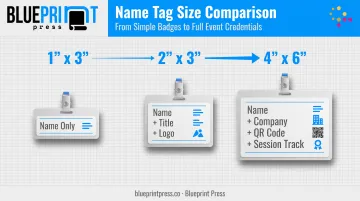
- A 1" x 3" badge leaves room for a name and maybe a title, nothing more
- A 2" x 3" badge can hold a name, title, department, and a larger logo without crowding
- A 4" x 6" event credential has enough real estate for a name, company, QR code, and session tracks
There's no single universal name tag size mandated anywhere. What counts as "standard" is a supplier convention built around common use cases, not a regulated dimension. The right choice comes down to matching size to purpose: daily employee wear calls for something different than a one-time conference badge.
Standard Name Tag Sizes and Dimensions
Most name tags on the market fall into a handful of recognized size categories. NameBadge.com's sizing guide identifies 1.5" x 3" as the most common standard size, offering enough room for a name, title, and small logo without feeling bulky. Use the quick reference below, then scan the notes for each size.
| Category | Dimensions | Best fit |
|---|---|---|
| Small | 1" x 3" | Name only or name + short title |
| Standard | 1.5" x 3" | Name, title, small logo (2–3 lines) |
| Large | 2" x 3" | Name, title, department, larger logo |
| Executive | 2" x 3.5" | Longer names, premium branding |
| XL / Photo ID | 2.5" x 4" | Headshot, ID number, QR/barcode |
Small (1" x 3")
This is the minimal option, fitting a name only or a name plus short title. It's common for retail staff, volunteers, and short-term events where the badge doesn't need to carry much information or last more than a few days.
Standard (1.5" x 3")
The default choice across corporate, healthcare, and hospitality settings. It comfortably fits a name, title, and small logo, typically two to three lines of text, without looking crowded on a shirt or lapel.
Large (2" x 3")
The extra height accommodates a full name, title, department, and a bigger logo. Organizations that need to display more credentials, like healthcare facilities listing certifications, often move up to this size.
Executive (2" x 3.5")
A wider, premium format built for longer names and more prominent branding. Some suppliers spec their executive line closer to 1.25" x 3.5", so dimensions vary slightly by printer. The intent stays the same: a polished look for law firms, financial institutions, and C-suite badges.
XL / Photo ID (2.5" x 4")
The largest common standard option, designed for headshot photos, employee ID numbers, and QR or barcode elements on security credentials. Dimensions vary more here than in other categories. Standard photo ID cards often run 3.375" x 2.125", matching the credit-card-sized CR80 format used for access badges.
Full-service print providers can typically go beyond these categories, too. Custom dimensions roughly in the 0.75" to 5" wide by 0.5" to 4" tall range are available from union shops like Blueprint Press. That includes logo-matched die cuts and branded shapes when a standard rectangle isn't enough.
How to Choose the Right Name Tag Size
Picking a size comes down to balancing a few practical factors, not following one universal rule.
Amount of Information Needed
Name-only badges fit comfortably on small sizes. Once you're adding a title and logo, Standard becomes the floor. Department names, credentials, or certifications push you toward Large or Executive formats.
Industry and Setting
Different industries have settled into different norms:
- Retail and hospitality lean small-to-standard for lightweight, all-day comfort
- Healthcare and corporate offices lean standard-to-large to fit credentials and branding
- Trade shows and conferences often use 3" x 4" to 4" x 6" badges for room-wide visibility, per Cvent's badge design guidance
Viewing and Readability Distance
Close-range wear, roughly 1 to 3 feet, works fine with smaller badges and standard font sizes. Anything read from farther away needs both a bigger badge and bigger type.
For event badges meant to be read from 10 feet, pc/nametag recommends attendee names in 36-40 point type, stepping down about 4 points per line for titles and organization names.
A standard 1.5" x 3" badge usually works fine with 18-24 point name text and 12-14 point titles.
Material and Attachment Type
Heavier materials like metal or engraved wood pair better with mid-to-large sizes, since the extra surface area helps balance the weight and keeps the badge comfortable. Lightweight pin-back plastic suits smaller badges just fine.
Ordering Custom or Branded Sizes
Sometimes none of the standard categories match what you actually need. Maybe you're matching an existing badge system, replicating a logo silhouette, or aligning with event branding. In those cases, custom-cut name tags solve the problem.
Full-service union print shops like Blueprint Press can produce custom-sized name tags alongside signage, apparel, and other business or campaign materials in one order. That cuts down on juggling multiple vendors and separate turnaround times.

Common Name Tag Sizing Mistakes to Avoid
A few sizing missteps show up again and again in orders, and most are easy to catch before you print:
- Assuming one size fits every department or event without matching badge size to text volume or reading distance
- Shrinking font size too far to cram extra text onto an undersized badge, which defeats the point of wearing one
- Overlooking backing hardware space, since magnets, pins, and clips all need room within the overall dimensions
- Choosing an event-sized badge for everyday employee wear, which gets uncomfortable over long shifts
Catching these before an order ships saves a reprint and avoids handing out badges nobody wants to wear.
Frequently Asked Questions
What is the standard size of a name tag?
1.5" x 3" is the most common standard size, offering enough room for a name, title, and small logo without feeling bulky or oversized.
What size name badge is easiest to read?
1.5" x 3" offers the best balance for close-range reading. For distance visibility, such as trade show floors, 2" x 3" or larger paired with bigger font sizes works better.
Can I fit a logo on a small name tag?
A logo can fit on a 1" x 3" badge, but it will be small. For a clearly visible logo alongside text, go with 1.5" x 3" or larger.
What size name tags do hospitals and nurses typically use?
1.5" x 3" or 2" x 3" badges are common in healthcare, since they fit credentials, department information, and facility branding without crowding.
Does name tag size affect the price?
Standard sizes are typically priced similarly across most providers. Custom shapes or nonstandard dimensions may carry a small added cost—request a quote for exact pricing.
What is the size of a conference or event name tag?
Conference badges commonly run 3" x 4" to 4" x 6", large enough to fit names, company info, and QR codes readable from across a room.