Picking the wrong one isn't just a cosmetic problem. A vinyl banner stretched across a chain-link fence in a windstorm can tear apart in hours, and a sign that can't handle Arizona's triple-digit heat won't survive a full campaign season.
This guide breaks down what each material is made of, what it costs, how long it lasts, and where each one actually belongs. By the end, you'll know exactly which banner fits your next storefront opening, rally, or job site fence.
Key Takeaways
- Vinyl banners use solid PVC for vibrant graphics: best for storefronts, indoor events, and low-wind settings.
- Mesh banners use small perforations (~30% open) so wind passes through instead of stressing the sign.
- Vinyl costs less upfront; mesh costs more per sq ft but often lasts longer outdoors.
- Choose based on wind exposure, location, and how long the banner must stay up.
- Many campaigns and job sites use both materials for different parts of the same project.
Mesh vs Vinyl Banners: Quick Comparison
Here's how the two materials compare side by side:
| Factor | Vinyl Banners | Mesh Banners |
|---|---|---|
| Cost | Lower cost per square foot; common for short-term promotions | Slightly higher upfront, but can reduce replacement costs long-term |
| Composition | Solid 13oz–18oz PVC with a smooth, glossy or matte surface | Perforated vinyl-mesh blend (roughly 70/30) woven for airflow |
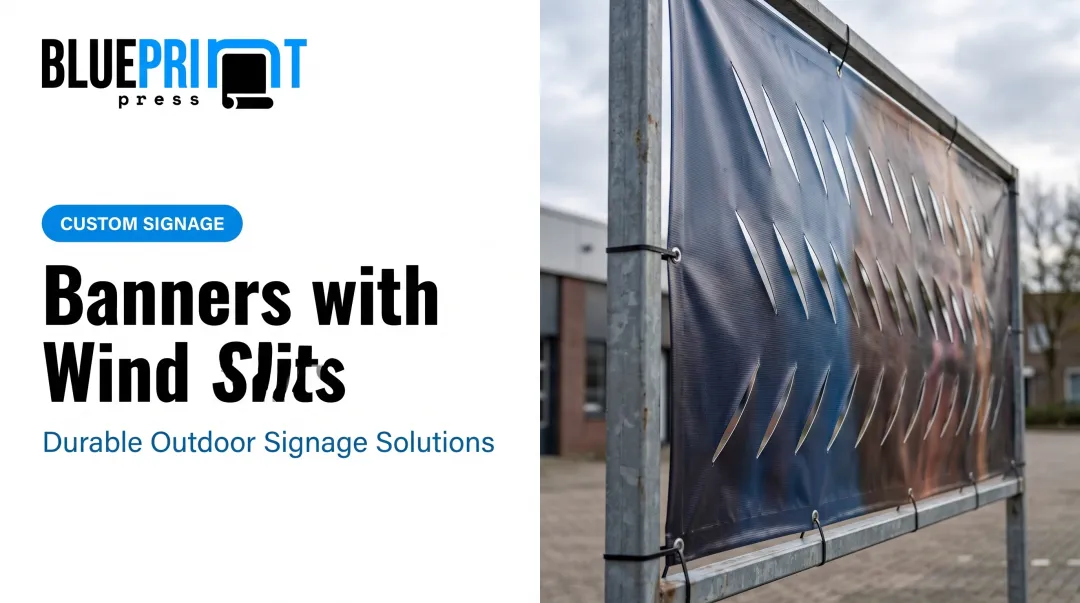
| Wind & Weather | Can act like a sail without wind slits; strong water repellency | Air passes through the weave, cutting wind load and tear risk |
| Print Quality | Sharp detail, rich color, ideal for close viewing; supports double-sided printing | Full color available, though slightly muted; reads well at a distance |
| Best Placement | Storefronts, walls, indoor events, sheltered outdoor areas | Fences, scaffolding, construction sites, sports fields |
Neither column is objectively "better." Vinyl wins on image sharpness and price. Mesh wins on wind survival. The right pick depends entirely on where the banner will hang.
Mesh Banners: Composition, Benefits, and Where They Work
A mesh banner is a perforated form of vinyl, not a separate material class. Most use a woven vinyl-mesh blend, roughly 70% vinyl to 30% open weave, so air passes through the surface instead of pushing against it like a sail.
How Mesh Banners Are Built
That breathable weave is why mesh dominates in wind-prone or extreme-heat climates like Arizona. A commonly used 10 oz PVC-coated polyester mesh permits about 30% airflow, a spec built for large building wraps, stadium graphics, and fence installs as documented by Ultraflex Systems.
Core benefits include:
- Reduced wind load: air moves through the material instead of catching it
- Tear resistance: far less strain on grommets and hems during gusts
- Longer usable lifespan when stored and cared for properly between installs
- Reusability across multiple events or campaign stops
Mesh also comes in different weights and finishes. Lighter mesh (around 8–10 oz) suits sustained wind exposure, while finishing details like hemming, grommet spacing, and reinforced edges affect how well the banner holds up once it's mounted.
Where Mesh Banners Perform Best
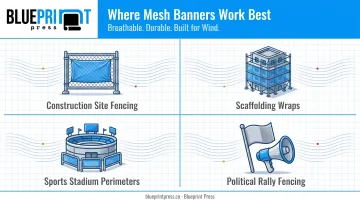
Mesh performs best where wind meets long install timelines:
- Construction site fencing that needs to stay up for months
- Scaffolding wraps on buildings under renovation
- Sports stadium perimeters exposed to open-air gusts
- Political rally fencing and large outdoor festival grounds
Manufacturer guidance backs this up. In one sourcing example, a 9 oz mesh banner outperformed a 15 oz solid frontlit banner on a windy building wrap: the solid material acted like a sail and risked tearing its grommets out, while the mesh held steady according to Ultraflex's banner selection guide.
When wind is constant, choose breathability over bulk. Mesh keeps large outdoor installs intact without overloading the hardware.
Vinyl Banners: Composition, Benefits, and Where They Work
Vinyl banners are the standard for a reason. They're made from solid PVC material, usually in 13oz to 18oz weights, with a smooth, opaque surface that produces some of the sharpest, most vibrant graphics available in large-format printing.
How Vinyl Banners Are Built
That non-porous surface means every ounce of ink stays on top instead of bleeding through perforations. This gives vinyl a real edge for:
- Vibrant color reproduction and crisp logo detail
- Double-sided printing without ghosting between sides
- Cost-efficiency for short-to-medium term campaigns
Weight matters here too. A 13oz standard vinyl works fine for storefronts, seasonal promos, and sheltered outdoor spots. An 18oz heavy-duty vinyl — often built on a denser scrim for added rigidity — holds up better in harsher outdoor conditions and supports full opacity for two-sided printing.
Finish options run from glossy (punchier color, more reflection) to matte (better readability under direct sun, less glare).
At Blueprint Press, vinyl and wide-format jobs run through a union shop built for Arizona's climate. Most banners are same-day, priced roughly $52 to $230 per banner depending on size and quantity. They're made to hold color through a full campaign season of desert heat instead of fading by month two.
Where Vinyl Banners Perform Best
Vinyl is the default choice whenever image quality and close-range readability matter more than wind survival:
- Grand openings and storefront announcements
- Trade show backdrops and booth signage
- Political campaign offices and indoor rally staging
- Corporate event backdrops for photos and press coverage
Retail, real estate, and campaign offices lean on vinyl constantly because viewers stand close enough to read the fine print. Mesh's slightly muted surface isn't built for that.
Mesh vs Vinyl Banners: Which Is Better for Your Project?
There's no universal winner here. The right material comes down to five practical questions:
- Where is it installed? Fenced or open-air locations favor mesh; walls and storefronts favor vinyl.
- How much wind exposure? Sustained wind almost always points to mesh.
- How far will people view it from? Close-up viewing rewards vinyl's sharper print quality.
- What's the budget? Vinyl is typically cheaper upfront.
- How long does it need to last? Extended outdoor campaigns favor mesh's durability.
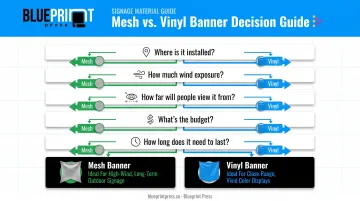
Choose vinyl if you're indoor, sheltered, or need maximum color and photo clarity. Choose mesh if you're outdoor, exposed to wind, or covering fencing and scaffolding for weeks or months at a stretch.
Here's a scenario that plays out constantly on job sites: a construction company wraps its perimeter fencing in solid vinyl for branding. The first real windstorm hits, and the banner balloons out like a parachute, straining every grommet along the top rail.
Manufacturer testing backs this up. A solid 15 oz banner can act like a sail in sustained wind, while a lighter mesh alternative lets that same wind pass straight through (per Ultraflex's material guidance). Swap to mesh on that fence line, and you drop both the wind risk and the monthly repair bill.
Match the material to the mounting location before you match it to your budget. If you're not sure which way to go, request a custom banner quote through Blueprint Press and describe your installation site (indoor, storefront, fence line, or similar). Same-day union printing means you won't lose campaign time figuring it out.
Conclusion
Mesh and vinyl banners solve different problems. Vinyl delivers sharper graphics and lower upfront cost for storefronts, trade shows, and sheltered spaces. Mesh trades a bit of image crispness for wind survival on fences, scaffolding, and exposed outdoor sites.
Get the match right, and you save on replacement costs, avoid mid-campaign downtime, and keep your signage looking sharp for as long as it needs to stay up — whether that's a weekend grand opening or a full election season.
Frequently Asked Questions
Should I get a mesh or vinyl banner?
It depends on where the banner goes up. Choose mesh for windy, fence-mounted outdoor spots, and vinyl for indoor or low-wind settings where color impact matters most.
What are mesh banners commonly used for?
Mesh banners are typically used for construction site fencing, scaffolding wraps, sports field perimeters, and other locations with heavy, sustained wind exposure.
Is mesh the same as vinyl?
Not exactly. Mesh banners are usually a blend of vinyl and open mesh material, often around 70/30, so they’re related to solid vinyl but perform differently.
How long do vinyl and mesh banners typically last outdoors?
According to Signs.com, solid vinyl lasts roughly 1–3 years outdoors and mesh around 2–3 years, depending on UV exposure, wind, and storage between uses.
Can mesh banners be printed in full color like vinyl?
Yes. Mesh banners support full-color graphics and text, though colors appear slightly less vibrant than solid vinyl because of the perforated surface.
Which banner material is more cost-effective for political campaigns?
Vinyl is usually cheaper upfront for short campaigns. For extended campaign seasons or high-wind rally sites, mesh can cost less overall once you factor in fewer replacements.