Introduction
A well-placed banner can stop a driver at a stoplight or draw a crowd into a storefront in seconds. That's the kind of return few marketing tools can match.
Businesses, nonprofits, and political campaigns lean on banners because they're fast to produce, cheap to deploy, and impossible to scroll past.
Out-of-home advertising consistently ranks among the best audience ROI of major media channels, and banners are one of the most accessible formats in that space.
Pick the wrong material or style and your banner can fade in the sun, tear in the wind, or disappear at a distance. This guide breaks down banner types by material and by style, then walks through how to pick the right one for your goal, budget, and setting.
Key Takeaways
- Banners fall into two groups: by material (vinyl, mesh, fabric) and by style or use
- Style options include retractable, hanging, step-and-repeat, and feather flags
- Choose based on location, lifespan, and message purpose—not price alone
- Vinyl and mesh suit outdoors; fabric performs best indoors
- Blueprint Press same-day union printing keeps campaign and event deadlines on track
What Is a Banner and Why Does It Matter?
A banner is a flexible, non-rigid printed material, typically vinyl, fabric, or mesh, designed to display a message, logo, or graphic. It's mounted or hung using grommets, pole pockets, stands, or cables.
Many in the sign industry draw a rough line between banners and flags: banners are usually anchored at multiple points, while flags attach along a single pole. That said, plenty of products (feather flags included) blur this line, so treat it as a general guideline rather than a hard rule.
Why the Right Banner Matters
Banners drive real business outcomes:
- Brand visibility at storefronts, events, and job sites
- Foot traffic for retail stores and grand openings
- Campaign messaging for political and advocacy groups
- Low cost-per-impression compared to sustained digital ad spend
Choose the wrong type, though, and problems show up fast. Faded ink, wind-torn edges, text you can't read from the parking lot, or a flimsy backdrop at a press event are all avoidable. Those failures almost always trace back to the wrong material or format for the job.
Matching banner type to where and how you'll use it prevents that waste.
Types of Banners by Material
Material is the first major decision point. It determines durability, whether a banner belongs indoors or outdoors, and how much it costs.
Vinyl Banners
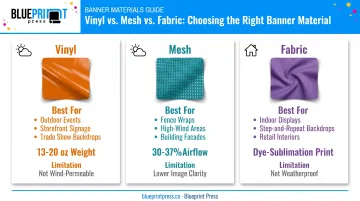
Vinyl is the industry workhorse. It's heavy-duty, weatherproof, and equally at home indoors or outdoors. Manufacturers commonly use coated vinyl in the 13-15 oz range for standard outdoor use, with heavier 15-20 oz options for longer-term outdoor installs, according to Ultraflex's banner material guide.
Finishing options typically include:
- Grommets for hanging on fences, poles, or frames
- Pole pockets for a clean, wind-resistant fit
- Hemmed edges for a finished, tear-resistant border
Best for: storefronts, political campaign signage, construction sites, and anything that needs to survive months outdoors.
Blueprint Press builds vinyl and wide-format banners for Arizona's extreme heat, so they stay sharp for a full campaign season, not just a weekend.
Limitation: vinyl is heavy and can crease if folded or stored improperly. Roll it, don't fold it.
Mesh Banners
Mesh is essentially perforated vinyl. Instead of catching wind like a sail, air passes straight through, which matters for large-format installs in exposed, high-wind locations.
- Common uses: building wraps, fence coverings, and construction site screening
- Airflow openings typically range from 30% to 37%, depending on the product
- Lower wind load than solid vinyl on large outdoor faces
Best for: large outdoor installs in exposed or high-wind locations
Limitation: the perforated surface slightly dulls color vibrancy and distance visibility compared to solid vinyl. If your site is calm and vivid color matters more than wind resistance, solid vinyl usually wins.
Fabric and Polyester Banners
Fabric banners use dye-sublimation printing, which produces rich, wrinkle-resistant color that's hard to match with other materials. They're typically stretched over tension frames or finished with pole pockets for a smooth, seamless look.
- Built mainly for indoor or covered use
- Specialty outdoor-rated polyester fabrics are available for some projects
- Finished on tension frames or with pole pockets for a smooth, seamless look
Best for: trade shows, retail displays, and step-and-repeat backdrops
Limitation: standard fabric banners aren't a fit for open-air, unprotected outdoor exposure. Indoors or under a tent, fabric is often the better visual choice over vinyl.
Types of Banners by Style and Use Case
Material affects durability. Style and hardware affect how portable, permanent, or event-ready a banner is, and that is the second decision every buyer needs to make.
Retractable (Roll-Up) Banners
These vertical prints roll into a base for quick setup and even quicker teardown. No tools, no hardware bag to lose.
Best for: trade shows, lobbies, and point-of-sale promotions where portability and speed matter more than sheer size.
Limitation: most standard retractable banners run 24 to 36 inches wide, though premium lines now stretch up to 48 or even 60 inches for buyers who need more real estate without sacrificing portability.
Hanging and Pole Banners
Rectangular prints suspended via grommets, cables, or brackets from ceilings, poles, or fences. Think boulevard banners lining a downtown street, or a campus branding campaign spanning a courtyard.
Best for: grand openings, boulevard advertising, and large-space branding.
Limitation: installation takes more time and hardware than a stand-based option. Plan for setup labor, not just print time.
Step and Repeat Banners
These are backdrop banners featuring a repeating logo pattern, built for professional photo coverage at galas, product launches, and press conferences. Matte finishes cut camera glare, and most stands are built for stable indoor floors rather than wind or uneven ground.
Best for: red-carpet events and press check-ins where a polished photo backdrop matters.
Limitation: the stand hardware generally isn't built for prolonged outdoor exposure, so keep these under a roof.
Feather Flags
Tall, curved flags on flexible poles that move with the breeze, catching attention through motion rather than static size.
Best for: retail storefronts, real estate open houses, and roadside promotions where you need eyes from a distance.
Limitation: the narrow, curved shape works best with short text or a logo, not paragraphs. Keep the message simple.
How to Choose the Right Type of Banner
The right banner matches your venue, timeline, and goal—not just the most popular or cheapest option.
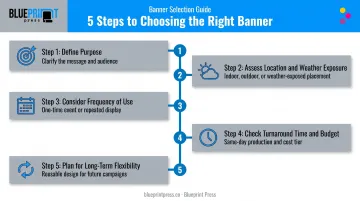
- Define the purpose. Is it announcing an event, promoting a sale, directing foot traffic, or serving as a photo backdrop? Each goal points toward a different style.
- Assess location and weather exposure. Fabric belongs in controlled indoor environments. Vinyl and mesh handle outdoor sun, rain, and wind. Mesh works especially well in high-exposure, windy spots.
- Consider frequency of use. A one-time event can lean on more affordable materials. A recurring campaign or seasonal storefront push justifies investing in reusable, weather-resistant options.
- Check turnaround time against your budget. Time-sensitive launches and campaign kickoffs need a print shop that won't stall your timeline. Blueprint Press offers same-day production on most jobs, which becomes a decisive advantage when an event is a week (or even a day) away.
- Think about long-term flexibility. Will this banner get reused across multiple events? Resized? Updated with new messaging next season? Answering that upfront can save a second print order later.
Common Mistakes to Avoid When Choosing a Banner
First-time banner buyers often make the same mistakes:
- Overspending on premium fabric for outdoor use when weatherproof vinyl or mesh would perform better and cost less
- Ignoring wind, sun, or rain exposure at the display site, leading to faded colors or torn material within weeks
- Underestimating turnaround time, especially for time-sensitive events like campaign launches or grand openings
- Chasing the lowest price without checking print quality, ink durability, or finishing details like grommets, hems, and reinforced corners
Avoid them by matching the material and format to the real display environment before you order—not after.
Conclusion
Banners remain one of the most effective, affordable tools for driving visibility across storefronts, events, and campaigns. Vinyl, mesh, fabric, retractable, hanging, step-and-repeat, and feather flag formats each solve a different mix of budget, environment, and durability needs.
Match the format to your use case, and work with a printer that can keep pace with your timeline. That pairing turns a banner order into signage that gets real results.
Frequently Asked Questions
What is a banner style?
Banner style refers to the format and hardware used to display it (retractable, hanging, step and repeat, or feather flag) as opposed to the material it's printed on.
What are the different types of banner designs?
Banner designs vary by material (vinyl, mesh, fabric) and by style (retractable, hanging, pole, step and repeat, feather flag). Match the material to conditions and the style to how you need the banner displayed.
How long do vinyl banners typically last outdoors?
Durability depends on vinyl weight, ink, and lamination. Quality outdoor vinyl with UV-resistant ink commonly lasts several months to a few years, depending on exposure.
What size banner do I need for my event or storefront?
Size should match viewing distance. A common starting guideline is roughly 1 inch of letter height for every 10 feet of intended viewing distance, adjusted for lighting and contrast.
Are mesh banners better than vinyl for outdoor use?
Mesh is better in windy, high-exposure areas because air passes through instead of catching like a sail. Solid vinyl offers richer color and better distance visibility in calmer settings.
How quickly can I get a custom banner printed?
Turnaround varies by provider and complexity, but many union print shops, including Blueprint Press, offer same-day production on most standard banner orders.