But pricing swings wildly. A subtle hood accent might run a few hundred dollars. A full custom-printed wrap on a luxury SUV can top $10,000.
This guide breaks down what drives that gap — vehicle type, wrap style, film quality, and labor — so you can budget with confidence, whether you're refreshing your daily driver or branding a fleet.
Key Takeaways
- Wraps range from roughly $1,000 for basic partial coverage to $10,000+ for premium custom-printed full jobs
- Vehicle size, film quality, design complexity, and installer skill are the biggest cost drivers
- Small cars and solid colors sit at the budget end; SUVs, trucks, and custom graphics push costs higher
- Business wraps need separate budget for design and printing, not just installation
- Paying more often pays off through longer durability and cleaner, resale-ready removal
How Much Does It Cost to Vinyl Wrap a Car? (Pricing Overview)
There's no single answer here. Cost depends on your vehicle's size, the wrap type you choose, film quality, and who installs it.
Three budgeting mistakes trip people up most often:
- Underestimating labor for curved panels: mirrors, door handles, and bumpers take real time
- Choosing cheap film that fades or lifts within a year in strong sun
- Forgetting design and printing fees entirely when budgeting for a branded wrap
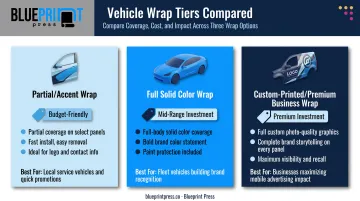
Here's how pricing typically breaks down across the market:
| Tier | Price Range | What You Get |
|---|---|---|
| Partial/basic | $500–$2,500 | Accent panels, single-color sections |
| Mid-range/standard full | $2,500–$5,000 | Full coverage, standard finish |
| High-end/custom or luxury | $5,500–$10,000+ | Custom graphics, premium film, larger vehicles |
These figures generally cover material and labor. They typically exclude paint correction, old wrap removal, and custom design or printing fees for branded work.
Partial or Accent Wrap
This covers select panels (hood, roof, mirrors, or a single color-change section) using standard vinyl.
Best for: budget-conscious owners wanting a style refresh or brand accent without paying for full coverage.
Full Solid Color Wrap
Complete exterior coverage in one gloss, matte, or satin finish, installed with standard techniques.
Best for: drivers wanting a full color change or a layer of paint protection without custom graphics.
Custom-Printed or Premium Business Wrap
Fully custom-designed graphics, logos, or specialty finishes like chrome or color-shift film, printed and installed edge to edge. Shops like Blueprint Press produce durable, branded wraps for businesses and campaigns that need graphics built for extreme heat. That matters if your vehicle spends summers parked in Arizona.
Best for: businesses, nonprofits, and campaigns using vehicles as mobile advertising, or owners chasing a show-quality finish.
Key Factors That Affect the Cost of a Car Wrap
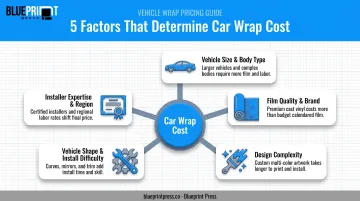
Final pricing depends on your vehicle, the vinyl you choose, how complex the design is, and who does the install.
Vehicle Size and Body Type
More surface area means more vinyl and more labor hours. A two-door hatchback might need a fraction of the material a full-size pickup or cargo van requires. Kelley Blue Book's published estimates show small cars running $1,800–$2,500 for a full wrap, while luxury vehicles reach $5,500–$10,000.
Film Quality and Brand
Not all vinyl performs the same, and the grade you pick shows up in both price and lifespan:
- Calendared vinyl costs less upfront and suits shorter-term or flatter applications
- Cast vinyl film costs more but conforms better to curves and lasts longer
For a vehicle you plan to keep for years, cast film is usually the better investment.
Design Complexity and Customization
A solid color is straightforward. Costs climb when the job needs extra design or print work:
- Custom-printed graphics or multi-color layouts
- Logo placement and brand-specific artwork
- Specialty finishes that require additional setup
That work hits the quote before installation even begins.
Vehicle Shape and Installation Difficulty
Size sets how much material you need; shape sets how long the install takes. Vehicles loaded with curves, creases, mirrors, and door handles simply take longer to wrap cleanly. A flat-sided box truck installs faster than a contoured sedan of similar size, and that time difference shows up directly in labor charges.
Installer Expertise and Regional Labor Rates
Certified, experienced installers charge more, but they cut the risk of bubbling, lifting, or a costly redo. Labor rates also shift by region — expect to pay more in a high-cost city than in a smaller market.
Cost Breakdown of a Car Wrap
That single "wrap price" you get quoted is really a bundle of separate cost components:
- Vinyl material (one-time) — Priced per square foot or linear foot; specialty finishes like chrome cost more than standard color
- Design and printing (one-time) — Graphic design, proofing, and large-format printing for custom or branded wraps
- Installation labor (one-time) — Charged per square foot or as a flat rate depending on vehicle complexity
- Paint prep or old wrap removal (optional) — Required when an existing wrap or paint flaws must be fixed first
- Aftercare products (recurring) — pH-neutral soap, microfiber cloths, and protective coatings that extend wrap life
Those line items stack quickly. Standard-color film retails around $11–$15 per linear foot, and installer labor commonly runs $3–$4 per square foot. All-in, a full wrap frequently lands at $12–$16 per square foot once material and labor combine—though this varies by region and film choice. For custom graphics, print shops such as Blueprint Press handle design and wide-format printing so you can source the film from one vendor before install.
Low-Cost vs High-Cost Car Wraps — What's the Difference?
Budget and premium wraps differ in more than the number on the invoice.
| Factor | Lower-cost wrap | Higher-cost wrap |
|---|---|---|
| Finish quality | Basic gloss or matte film; seams or texture inconsistencies may show | Cast vinyl with a factory-like finish and cleaner panel transitions |
| Durability | May fade or lift sooner, especially in intense sun | Longer service life with UV-resistant film and proper care |
| Long-term value | Cheaper upfront, but earlier reapplication adds cost over time | Better cost-per-year value, plus stronger paint protection |
Car and Driver notes that a professionally installed wrap under normal conditions typically holds up well for several years before showing wear. In high-sun climates, that durability gap makes the higher upfront cost easier to justify if you plan to keep the vehicle long-term.
How to Estimate the Right Budget for Your Car Wrap
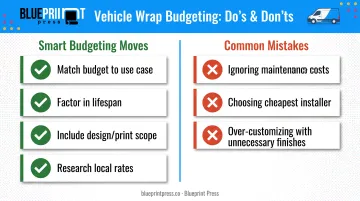
The right budget matches how you'll actually use the vehicle, not the lowest quote in your inbox.
Weigh these factors before you lock in a number:
- Use case: personal styling vs. business branding or mobile advertising
- Lifespan: how long you'll keep the vehicle, or how long the wrap must last
- Scope: installation only, or design and printing as well
- Local market: regional labor rates and installer reputation in your area
Avoid these common mistakes:
- Focusing only on upfront price and ignoring maintenance costs or shorter film lifespan
- Picking the cheapest installer without checking reviews or past work
- Over-customizing with specialty finishes you don't need: a business logo wrap rarely calls for chrome film
Frequently Asked Questions
Is it cheaper to wrap a car or paint?
For a basic single color, costs can land close to each other. For custom designs, multi-color graphics, or specialty finishes, wraps are usually cheaper since paint work escalates fast with added complexity.
Is it worth it to vinyl wrap a car?
Wraps make sense if you want reversible customization, added paint protection, or, for businesses, mobile advertising value. They're less worth it if your real goal is hiding significant body damage.
How long will a car wrap last?
A well-maintained wrap typically lasts 3–7 years, depending on film quality, climate exposure, and how consistently you clean and care for it.
Which is better, PPF or wrap?
PPF wins for pure paint protection with a clear finish. Vinyl wrap wins for color change and branding. Many owners combine both for maximum protection and style.
Can I wrap my car myself?
DIY kits exist and cost less upfront, but improper application often causes bubbling, tearing, or lifting. Professional installation remains the safer bet for a lasting result.
How much does a partial car wrap cost?
Partial wraps covering select panels like the hood, roof, or mirrors typically run $500–$2,500, depending on vehicle size and design complexity.