None of that happens by accident. "Standard" yard sign sizes exist because they balance visibility, portability, material cost, and compatibility with common stakes and frames. Get the size right, and everything downstream — legibility, mounting, budget — falls into place.
This guide covers standard dimensions, the factors that should drive your size choice, size recommendations by use case, custom options, and the sizing mistakes that trip up even experienced buyers.
Key Takeaways
- 18" x 24" is the most widely used standard yard sign size across real estate, political, and business signage.
- Choose size by purpose, viewing distance, local rules, and budget — not preference alone.
- Larger formats (24"x36" and up) boost visibility but need sturdier mounting hardware.
- Custom sizes and weatherproof materials extend sign life across seasons and climates.
- Political, real estate, and event signs each favor slightly different dimensions for their goals.
What Is the Standard Yard Sign Size?
A "standard" yard sign size is one of a handful of common, mass-produced dimensions that printers default to for cost efficiency, material yield, and stake compatibility. Stray outside these sizes and you'll often pay more per unit, simply because the material sheet doesn't cut as cleanly.
18" x 24" is treated as the industry default. Signs.com identifies it as the most common yard sign size overall, because it's large enough to read from a moving car but small enough to handle, ship, and stake with a basic wire frame.
Small Format Signs (9"x12" to 12"x24")
These sizes work best for close-range viewing (about 10 to 50 feet). Common uses include:
- Yard sales and garage sale directional signs
- Mini political signs for indoor windows or tight yards
- Pedestrian-facing signage at events or storefronts
Medium Format Signs (18"x24" to 24"x24")
This is the versatile middle range. Real estate agents, political campaigns, and small businesses lean on it because it works in most placements without specialized mounting:
- Front yards and sidewalk campaigns
- Storefront windows and lot entrances
- Short-run promotions where one size has to cover several locations
Large Format Signs (24"x36" up to 48"x96")
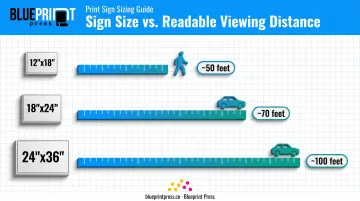
Once you're targeting busy roadways, sporting events, or major promotions, you need more surface area. Per 48HourPrint's viewing distance benchmarks, approximate legibility ranges are:
- 12"x18": about 50 feet
- 18"x24": about 70 feet
- 24"x36": about 100 feet
Because of their size and wind exposure, these larger formats typically need H-stakes paired with a supporting frame. A simple wire stake alone won't hold them upright in open terrain.
Factors That Influence Your Ideal Yard Sign Size
"Standard" doesn't mean "one-size-fits-all." The best size for your situation depends on a handful of practical variables that have nothing to do with personal taste.
Purpose and message complexity. A sign with a name, date, and phone number needs more surface area than a one-word "SALE" sign. More text means more space, or your message turns into a blur at 30 feet.
Viewing distance and location. This is probably the single biggest driver:
- High-traffic roads → 24"x36" or larger
- Residential yards and sidewalks → 18"x24" or smaller
- Indoor or close-up placement → 12"x18" or smaller
Local regulations and HOA rules. This one catches people off guard. Arizona, for example, caps political signs at 16 square feet in residential zoning and 32 square feet in nonresidential zoning.
Many HOAs impose tighter limits still, sometimes as small as 2'x2' during election season. Check local codes before you order, not after.
Duration of display. A weekend garage sale doesn't need the same material investment as a five-month campaign season. Match your material and size choice to how long the sign actually needs to survive outdoors.
Budget and material cost. Bigger signs use more coroplast or vinyl, which raises the per-unit price. If you're ordering in bulk for a campaign, that difference adds up fast across 100 or 500 units.
Standard Sizes by Use Case
Different industries have settled on different defaults, shaped by their own combination of visibility needs, budget, and regulation. Here's how the standard sizes break down by application.
Real Estate Signs
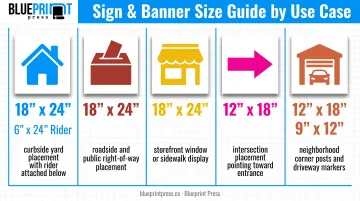
18"x24" (or its rotated version, 24"x18") is the real estate standard. It's commonly paired with a companion 6"x24" rider sign for status updates like "Sold," "Open House," or "Pending," so agents don't need to reprint the main panel every time a listing's status changes.
Political & Campaign Signs
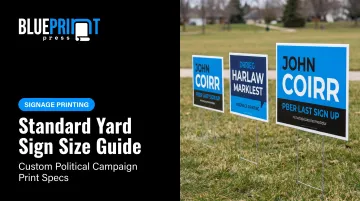
18"x24" is the most common political yard sign size for a simple reason: it satisfies most local election sign guidelines while staying affordable to print by the hundreds.
Blueprint Press produces 18"x24" campaign signs on weatherproof 4mm coroplast with UV-resistant inks, built to hold color and structure through a full campaign season.
Orders start at 50 signs from $330.00, with quantity tiers at 100, 150, 250, and 500. Rush production is available for last-minute canvassing pushes.
Business, Retail & Event Signs
Storefront promotions typically use 18"x24" for quick, at-a-glance messaging that drivers and pedestrians can catch in a few seconds.
Event or directional signage often favors smaller 12"x18" signs, since those are usually read at closer range (think wayfinding at a trade show or festival).
Yard Sales & Personal-Use Signs
For driveway or neighborhood signage, smaller formats do the job just fine. Most people don't need anything larger than:
- 12"x18" for main signs with an address or arrow
- 9"x12" for supplementary directional signs
Custom Sizes & Mounting Considerations
Most printers offer custom dimensions beyond the standard sizes when your design or space calls for it. Custom sizing still isn't free-form. Factor in material yield and stake or frame compatibility—even a few inches off standard proportions can require a different mounting setup.
Common mounting options include:
- Wire H-stakes: typically rated for signs up to 18"x24"
- Step stakes: widely used with corrugated plastic yard signs in standard sizes
- Dedicated sign frames: better for 24"x36" and larger formats, where wind load matters more
A shop like Blueprint Press can run same-day production and custom sizing on request, using materials built for Arizona heat. Businesses and campaigns get printing and delivery handled in one place instead of coordinating multiple vendors.
Common Mistakes to Avoid When Choosing a Yard Sign Size
A few errors show up repeatedly in yard sign orders. Watching for these can save you a reprint or a compliance headache.
- Assuming bigger is always better. Oversized signs can violate local codes or overwhelm a small residential yard, undercutting the professional look you're going for.
- Ignoring viewing distance. Even a standard 18"x24" sign becomes unreadable from the street if the text and graphics inside it are sized too small for the intended distance.
- Forgetting to budget for companion signage. Rider signs, directional arrows, and additional panels add to your total footprint and cost . Plan for them upfront, not as an afterthought.
- Overlooking material durability. A large sign without proper stakes or a frame blows over easily. That risk climbs fast in high-heat, high-wind Southwest conditions, where coroplast can warp without adequate support.
Frequently Asked Questions
What is the most common standard yard sign size?
18" x 24" is the most widely used size across real estate, political, and business signage. It balances street-level visibility with easy handling and affordable shipping.
What size yard sign do political campaigns typically use?
Most campaigns use 18" x 24" because it complies with the majority of local election sign guidelines while staying cost-effective for orders in the hundreds. Blueprint Press produces this exact size for Arizona and Southwest campaigns.
What size are real estate yard signs?
18" x 24" or 24" x 18" is the standard, often paired with a 6" x 24" rider sign for status updates like "Sold" or "Open House."
Can yard signs be made in custom sizes?
Yes, most printers offer custom dimensions on request. Just confirm stake or frame compatibility and check local sign code limits before finalizing your order.
Are there size restrictions for yard signs in residential areas?
Many cities and HOAs cap yard sign dimensions, especially for political and commercial signage. Arizona, for instance, limits residential political signs to 16 square feet. Check your local ordinances before ordering.
What's the best way to mount or display a yard sign?
Standard-size signs (up to about 18" x 24") typically use wire H-stakes. Larger formats need dedicated frames for added stability against wind.