Introduction
A campaign needs 500 yard signs by Friday. A nonprofit needs a donor mailing out the door before quarter-end. A retailer needs matching banners at 12 locations, all with the same shade of blue.
None of these organizations can justify buying a digital press, hiring a print operator, and stocking finishing equipment just to solve one problem. That's the reality most businesses, nonprofits, and campaigns face: they need professional printed materials on tight timelines, but owning the equipment rarely makes financial sense.
Common pain points show up fast:
- Expensive machines that sit idle half the year
- Missed deadlines when internal staff get pulled onto other tasks
- Inconsistent print quality between batches
This guide covers the real benefits of outsourcing, when to make the switch, what to look for in a print partner, and where Blueprint Press fits as a union-shop option built for speed.
Key Takeaways
- Outsourcing eliminates capital costs tied to presses, finishing equipment, and staff training
- The right print partner delivers fast turnaround, upfront pricing, and room to scale
- Political campaigns, nonprofits, and retailers benefit most due to volume and deadline pressure
- Union and ethical labor credentials matter to socially conscious brands and stakeholders
Key Benefits of Outsourcing Print Services
Cost Savings Without the Equipment Overhead
Running an in-house print shop means budgeting for digital presses, cutters, laminators, and the staff to operate them. Outsourcing turns that capital expense into a simple per-job cost instead.
In-Plant Impressions points to lower total cost of ownership and reduced technology-obsolescence risk as the core financial arguments for outsourcing. You're not stuck replacing equipment every few years as digital presses improve.
Costs avoided by outsourcing typically include:
- Upfront equipment purchases and financing
- Ongoing maintenance contracts and replacement parts
- Staff hiring, training, and downtime during transitions
- Software licenses for prepress and file management
Faster Turnaround, Fewer Bottlenecks
Dedicated print facilities run presses full-time, not squeezed between other office priorities. That difference shows up directly in delivery speed.
A 2025 PrintWeek printer poll found that 29% of print businesses identified very quick-turnaround work as their fastest-growing service area — more than any other category surveyed. Speed isn't a nice-to-have anymore; it's what clients are asking for most.
Blueprint Press, for example, offers same-day completion on most jobs in its business and campaign essentials category, including business cards, brochures, and banners.
Scalability, Consistency, and One Roof
Beyond cost and speed, outsourcing solves problems that internal teams struggle with regardless of budget:
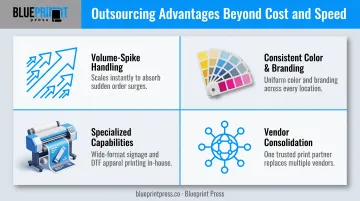
- Handles volume spikes without adding headcount or overtime during peak seasons
- Maintains consistent color and branding across every batch, especially for multi-location businesses
- Opens specialized capabilities — wide-format, vinyl, DTF apparel, and direct mail tracking — most companies can't justify owning
- Consolidates vendors so one partner covers production, shipping, and fulfillment instead of five separate contracts
In-House vs. Outsourced Printing: When to Make the Switch
The decision usually comes down to volume, speed requirements, and how much staff time your team can spare for print logistics.
| Factor | In-House Printing | Outsourced Printing |
|---|---|---|
| Equipment costs | Large upfront investment | None (converted to per-job cost) |
| Labor | Dedicated staff plus training | Handled entirely by the partner |
| Scalability | Capped by machine and staff capacity | Scales up or down with demand |
| Turnaround | Can bottleneck during busy periods | Built for volume and speed |
| Quality consistency | Varies with equipment age and upkeep | Standardized processes and color profiles |
There's No Universal Breakeven Number
Vendors love to throw out a magic volume threshold: "outsource once you hit 2,500 pieces a month." That number doesn't hold up.
PRINTING United Alliance's 2025 in-plant study covered operations ranging from under $500,000 to over $20 million in budget, with no single published breakeven point. The right answer depends on your fully burdened costs—labor, finishing, rush frequency, and delivery—not a headline figure.
When Speed-to-Market Wins the Argument
Some situations make outsourcing the obvious choice regardless of volume:
- Political campaigns racing compressed election timelines for signage and mailers
- Product launches where marketing materials can't slip the release date
- Time-sensitive events where a printer breakdown isn't an option
Signs Your In-House Setup Is Costing More Than It Saves
Internal production often spreads print work across departments, so true cost stays hidden. Watch for these quiet drains:
- Equipment purchases, maintenance, and eventual replacement
- Hiring and training time pulled from core roles
- Missed deadlines when a machine fails and staff scramble to recover
A hybrid model fits many teams: keep light everyday jobs in-house, and outsource large runs, specialty work, or rush projects when volume, speed, or staff time tip the scale.
What to Look for When Choosing an Outsourced Print Partner
Speed, color consistency, service range, and labor standards separate a reliable print partner from a vendor that creates last-minute problems. Check the areas below before you commit.
Turnaround Time and Production Capacity
Same-day or rush capability matters most when a campaign event, product launch, or trade show has a fixed date. Ask any potential partner exactly what qualifies for rush service: order cutoff times, file-approval windows, and finishing requirements all affect whether "fast" actually means fast.
Print Quality and Digital Press Technology
Digital press technology has closed the gap with traditional offset for short and mid-length runs, and in many cases surpassed it. PRINTING United Alliance notes that the G7+ color specification improves gray balance and tonal accuracy, particularly for high-density inkjet and saturated colors.
That gives buyers a clearer standard for judging color consistency across vendors.
Pricing, Scope, and Fulfillment
Confirm these operational basics alongside press quality:
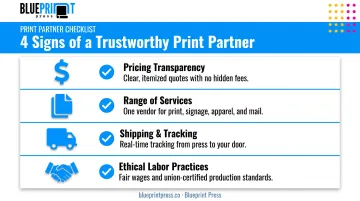
- Pricing transparency: Upfront quotes with no hidden rush fees—especially for nonprofits and campaigns on tight budgets
- Range of services: One provider for print, signage, apparel, and direct mail means a single point of contact
- Shipping and tracking: Real-time order tracking and direct-to-office delivery remove logistical guesswork
- Ethical labor practices: Union shops identify the plant that produced the work and follow wage and safety standards brand-conscious organizations often require
Industries and Use Cases That Benefit Most from Print Outsourcing
Political Campaigns and Advocacy Organizations
Campaigns run on compressed timelines and legal rules that leave zero room for printer delays. Outsourcing is often the only practical way to cover:
- FEC-compliant disclaimers on every public piece
- Mass mailings that meet the 500+ piece / 30-day thresholds
- Weatherproof signage that lasts a full election season
- Mailers that can ship on short notice
Nonprofits and Event Organizers
Nonprofits juggle limited budgets against high-volume mailing needs. According to M+R Benchmarks' 2025 data, nonprofit direct-mail revenue grew 9% last year. For every $1 raised online, participating organizations raised an average of $0.66 through direct mail. Print still carries real weight in fundraising.
Most nonprofits send around 15 mailings a year to active donors alone—a cadence that's tough to sustain without outside production support. Event organizers face the same squeeze: banners, badges, and handouts often need to be print-ready days before doors open.
Corporate Marketing Teams, Retailers, and Trade Show Exhibitors
Multi-location brands, retailers, and trade show exhibitors need signage, apparel, and promo materials that look identical whether they're printed in Phoenix or shipped to Chicago. Face-to-face events remain a top B2B channel, and mismatched banner colors or off-brand booth materials undercut that investment fast.
Outsourced production pays off on consistent color matching across locations, bulk apparel runs, and last-minute booth reprints when show plans change.
Blueprint Press: A Union Print Partner Built for Speed and Quality
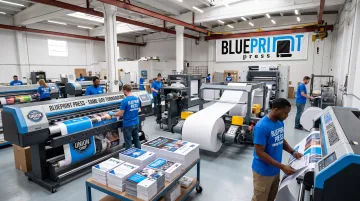
Blueprint Press is a Phoenix-based, full-service digital print shop serving Arizona, the broader Southwest, and, through shipping, all 50 states and Canada. It runs on advanced digital printing technology rather than traditional offset equipment, which is how it delivers same-day completion on most jobs.
What sets it apart:
- Same-day turnaround on most jobs in the business and campaign essentials category, including business cards, brochures, and banners
- Full-service capability across business printing, wide-format graphics, custom apparel, vehicle and wall wraps, and direct mail with real-time tracking
- 100% union-printed materials, produced under fair wages and safe working conditions across every product line
- Employee Direct Delivery throughout Arizona and surrounding states, plus real-time tracking for out-of-state shipments
For political campaigns, Blueprint Press produces weatherproof 18" x 24" yard signs on 4mm coroplast with UV-resistant inks, starting at $330 per order for quantities of 50.
For nonprofits and businesses, quotes typically fall into $500–$1,000, $1,000–$2,500, or $2,500–$5,000 ranges, with responses generally within 48 hours. Union labor, competitive Southwest pricing, and same-day capability make it a strong fit when you need speed without sacrificing ethical sourcing.
Frequently Asked Questions
How much does outsourced printing cost?
Pricing depends on quantity, paper stock, size, finishing, and turnaround. Short digital runs and larger volume jobs price very differently, so request a custom quote for accurate numbers on your specs.
Is it cheaper to outsource printing than print in-house?
For most volume levels, yes. Outsourcing eliminates equipment purchases, maintenance contracts, and dedicated labor costs that add up quickly even for moderate print volumes.
How do I choose a reliable print outsourcing partner?
Evaluate turnaround speed, pricing transparency, the breadth of services offered, and labor practices like union certification. A partner strong in all four areas typically handles both routine orders and last-minute rush jobs well.
Can outsourced printers handle rush or same-day orders?
Many modern digital print shops offer same-day or next-day turnaround, though it depends on job complexity, quantity, and finishing requirements. Always confirm the exact cutoff and SLA before assuming rush service applies.
What types of materials can be outsourced for printing?
Common categories include business collateral, signage, apparel, direct mail, and large-format graphics like banners and vehicle wraps. Full-service partners typically cover all of these under one roof.
Does outsourcing printing affect quality control?
Reputable print partners maintain strict quality checks and brand guideline adherence, often improving consistency compared to in-house production with aging equipment. Ask any potential vendor how they handle color accuracy across repeat orders before committing.