
Cotton soaks up ink. Nylon resists it. Results on nylon vary wildly depending on the weave type, the ink or transfer method you choose, your curing setup, and honestly, how careful the person running the press is that day. Not every bag labeled "printable" behaves the same way once it hits the platen.
This guide walks through the exact steps for printing on nylon bags, what you need before you start, the variables that make or break print quality, common failure points, and when it makes more sense to outsource the job entirely.
Key Takeaways
- Standard plastisol at 320°F won't bond to nylon without a catalyst or low-cure ink
- Catalyst ratio, cure temp, and mesh must match the weave (taffeta, oxford, satin) or prints fail
- Screen printing suits medium-to-large orders; heat transfer or DTF works better for small runs or coated fabrics
- Most failed nylon prints trace back to skipped prep steps, not "unprintable" fabric
- Shops without in-house gear can still get durable nylon prints through a pro print partner
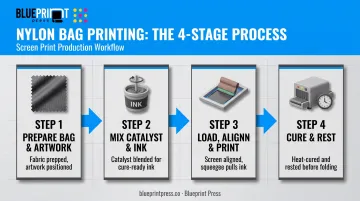
How to Print on Nylon Bags: Step-by-Step Guide
Step 1: Prepare the Bag and Artwork
Before touching a squeegee, identify what you're actually working with.
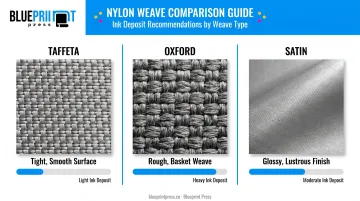
- Taffeta has a tight, plain weave that supports fine detail and crisp edges
- Oxford uses a rougher basket weave that needs a heavier ink deposit and coarser mesh
- Satin is smooth and lustrous, similar to taffeta in printability but glossier in finish
Next, test for a waterproof or PU coating. A water-droplet test works: if water beads up and rolls off instead of soaking in, the bag has a repellent finish that will resist ink regardless of catalyst.
Some shops use a rubbing alcohol wipe on an inconspicuous spot instead. That can leave a discolored patch on certain coatings, so test carefully before committing to the full run.
Finally, preshrink the bag. Run it through a conveyor dryer on low heat or give it a brief low-temp press pass. Skip this step and you risk print distortion after the final cure, since nylon can re-elongate overnight even if it was preshrunk the day before.
Step 2: Mix and Prepare the Ink or Transfer
If you're screen printing, add a nylon-bonding catalyst to your plastisol at the manufacturer's exact ratio by weight. Ratios vary significantly by brand:
| Catalyst System | Addition by Weight | Working Life |
|---|---|---|
| International Coatings 900 | 5% (20:1 ratio) | 4-8 hours |
| Avient Hugger 2940 | 10% | 4-8 hours |
| Avient Nylobond | 10-15% | 8-12 hours |
Never borrow one brand's ratio for another. Avient's Wilflex guide confirms standard plastisol cures around 320°F, while nylon-specific formulas run cooler and require this precise catalyst chemistry to bond at all.
Mix only what you'll use during the working window. Catalyzed ink keeps reacting once mixed, and leftover residue in a screen can damage it.
Not screen printing? Prepare a heat-transfer film or DTF transfer sized to your artwork instead, skipping the catalyst math entirely.
Step 3: Load, Align, and Print the Bag
Nylon shifts. A lot. Secure the bag flat on the platen using a jacket hold-down device rather than relying on tape or a standard pallet.
Before you print:
- Smooth out every wrinkle. Nylon wrinkles easily, and any fold under the screen distorts the design
- Position the bag with roughly 1/16 to 1/8 inch off-contact from its highest point
- Load a sharp 70-80 durometer squeegee (some shops prefer a triple-durometer blade for added control)
Then print with one confident stroke. This matters more on nylon than almost any other fabric. A second pass nearly always causes blurring, doubling, or ghosting because the bag has already shifted slightly under the screen.
Step 4: Cure or Press the Design
Curing catalyzed ink is where most DIY jobs go sideways. Lower the temperature and extend the dwell time compared to standard plastisol:
- International Coatings' current 900 series specifies 275-325°F for about one minute, with the entire ink film reaching temperature
- Nylobond caps out at 285-300°F to avoid damaging the fabric
- Heat-pressed transfers rated for woven nylon commonly run 290-320°F for 12-15 seconds
Applying a transfer instead of screen printing? Follow the manufacturer's spec sheet exactly. Transfer Express lists specific woven-nylon settings around 305°F for 15 seconds at 70 psi for one of its nylon-rated films. Not every transfer product is built for this fabric.
Once cured, let the bags rest. Full adhesion isn't instant. Some catalyst systems need 24 to 72 hours before the bond fully hardens, so don't fold, pack, or wash finished bags right off the dryer.
When and What You Need Before Printing on Nylon Bags
When This Method Makes Sense
Catalyzed screen printing pays off on medium-to-large orders—campaign totes, event giveaways, or retail runs—where setup cost spreads across enough bags to matter.
For one-off orders or heavily coated waterproof nylon, screen printing is often the wrong tool. Heat transfer or DTF usually delivers faster, more consistent results without the catalyst chemistry.
Equipment, Materials, and Skill Readiness
At minimum, you'll need:
- A screen printing press (or a heat press if you are using transfers)
- A conveyor dryer or flash unit capable of sustained, controlled low heat
- Retensionable monofilament polyester screens (125–355 mesh, depending on weave and ink type)
- A sharp squeegee and a bag platen or hold-down device
Before running anything, confirm your ink or transfer is explicitly rated for synthetic fabric. Check the bag for a waterproof coating that could block bonding entirely.
Operators need real familiarity with catalyst mixing ratios, dryer temperature control, and proper ventilation. Some additives release fumes that require adequate airflow.
Key Parameters That Affect Results When Printing on Nylon Bags
Getting nylon prints right comes down to controlling a handful of tightly linked variables, not just owning good equipment.
Ink or Catalyst Ratio
Too little catalyst and the ink sits on the surface instead of bonding, leading to peeling within a few washes. Too much wastes ink and shortens your working window. Stick to the manufacturer's published percentage, whether that's 5% or 15% by weight, and weigh it rather than eyeballing it.
Curing Temperature and Dwell Time
Nylon scorches well below its true melting point (bulk nylon 6 melts around 426°F). Coatings and finishes can wrinkle or discolor at much lower heat, so most nylon bag jobs cure in a lower band—often roughly 270–320°F—with dwell long enough for a full bond, commonly 60–90 seconds depending on the ink system.
Curing too cool leaves ink sitting on the surface. Curing too hot damages the fabric before the ink sets. Always confirm the ink maker’s temp and dwell chart on a scrap panel before the production run.
Nylon Weave Type
| Weave | Surface | Ink Deposit Needed |
|---|---|---|
| Taffeta | Tight, smooth | Lighter deposit, fine detail |
| Oxford | Rough, basket weave | Heavier deposit to avoid jagged edges |
| Satin | Smooth, lustrous | Moderate deposit, good opacity |
Mismatching mesh count to weave is one of the fastest ways to end up with patchy coverage.
Fabric Coating and Waterproofing
PU-coated or waterproofed nylon repels ink no matter how much catalyst you add. Before a full run, drop water on a hidden area or print a small scrap swatch—if beads sit on the surface or the ink rubs off, strip or switch materials. Skipping that check drives defect and peel rates on finished bags.
Common Mistakes and Troubleshooting When Printing on Nylon Bags
Three mistakes show up constantly on nylon jobs:
- Skipping the preshrink step, which causes visible distortion once the print cures and the fabric settles
- Using standard high-temp plastisol without a catalyst, which leaves ink sitting on top of the fabric where it cracks almost immediately
- Running multiple squeegee strokes, which blurs or doubles the print on nylon's slick, shifting surface
If a job still fails after you correct these, match the symptom to the fix below.
Problem: Ink Peels or Cracks After Washing
Likely cause: insufficient catalyst ratio, or washing before the full cure window has passed.
What to check: verify the catalyst percentage against the manufacturer's spec, and extend the rest period, sometimes up to 72 hours, before the first wash.
Problem: Blurred or Ghosted Print
Likely cause: multiple squeegee passes, or the bag shifting mid-print because it wasn't secured.
What to check: switch to a single-stroke technique and add a proper bag hold-down before your next pass.
Problem: Print Distorts After Curing
Likely cause: fabric wasn't preshrunk, so heat from curing tightened the nylon under the ink.
What to check: wash or heat-set the next batch before printing, then re-test cure temperature so you don't overshrink.
Alternatives to Screen Printing on Nylon Bags
Screen printing isn't always the fastest or most cost-effective route, especially for smaller runs or heavily coated nylon.
Heat Transfer Vinyl or Pre-Made Transfers
When it's better: small-batch orders where buying catalyst chemistry and burning screens isn't worth the investment.
Key trade-offs: higher per-unit cost at scale, and a noticeably different hand-feel than direct-bonded ink. Key trade-offs: higher per-unit cost at scale, and a noticeably different hand-feel than direct-bonded ink. On coated nylon, adhesion can also fail sooner with wash or abrasion than a properly catalyzed screen print.
Direct-to-Film (DTF) Transfers
When it's better: full-color or gradient designs, mixed-fabric orders, or fast turnaround without screen setup.
Key trade-offs: requires DTF equipment or outsourcing, and not every DTF product is rated for nylon. Some major suppliers explicitly exclude nylon from their standard film specs, so confirm compatibility before you commit.
Blueprint Press runs DTF suited to synthetic fabrics, so you skip in-house catalyst ratios and still get durable color on nylon bags.
Outsourcing to a Professional Union Print Shop
When it's better: campaigns, nonprofits, and businesses that need guaranteed quality and quick turnaround without buying a press, dryer, and screens outright.
Key trade-offs: higher per-unit cost on very small runs if you already own equipment, but you drop the defect risk from untested catalyst ratios and cure settings.
Blueprint Press, a union print shop in Phoenix, offers same-day turnaround on most jobs and ships nationwide—useful when you want durable nylon bag prints without running chemistry on your own dryer.
Conclusion
Printing on nylon bags comes down to matching ink or catalyst, temperature, and prep to the specific weave and coating in front of you. Nylon can hold a durable print, but it is less forgiving than cotton.
Most failures trace back to rushed prep, like skipping the preshrink or coating test, rather than bad equipment. If you don't have time to dial in catalyst ratios and cure windows yourself, a shop like Blueprint Press can deliver the same durability without the guesswork.
Frequently Asked Questions
Can you print on a nylon bag?
Yes. Nylon bags can be printed using catalyzed inks, heat transfers, or DTF. The slick surface needs extra prep—coating tests and preshrinking—compared with cotton.
Can I heat press on 100% nylon?
Yes, but only with low-temperature transfers rated for synthetic fabrics, typically 300–320°F or lower. Standard high-heat transfers will scorch or melt the material.
What type of ink is best for printing on nylon bags?
Catalyzed plastisol or specialty low-cure inks are built for nylon bonding. DTF film transfers are a strong alternative when the film is confirmed compatible with nylon.
How long does it take for ink to fully cure on nylon?
Initial curing happens in the dryer or press within a minute or two, but catalyzed inks may need up to 72 hours of rest to reach full hardness and wash resistance.
Can waterproof or coated nylon bags be printed on?
PU-coated or waterproofed nylon often repels ink regardless of catalyst use. Run a water-droplet or alcohol-wipe test before committing to a full print run.
Is it cheaper to print nylon bags in-house or order from a print shop?
In-house printing pays off at high volume if you already own the equipment. Small-to-medium runs are typically faster and more cost-effective through a professional union print shop.