Introduction
Drive past any street-spanning banner or light pole sign, and you'll probably spot a row of half-moon cuts punched through the vinyl. It's a practice so common that most people assume it's essential: cut slits, let wind pass through, save the banner.
But the physics doesn't back that up. Slits open up too little surface area to reduce wind load in a meaningful way. In some cases, they make vibration and stress worse, not better.
This guide breaks down what wind slits actually do and why the traditional theory falls apart under testing. You’ll also see what businesses, nonprofits, and campaigns should use instead for banners that need to survive real wind.
Key Takeaways
- Wind slits typically open 3% or less of a banner's total surface area, not enough to meaningfully cut wind load
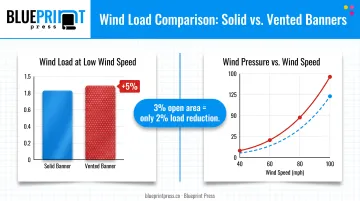
- University wind tunnel testing found vent holes can increase load by up to 5% at lower speeds
- Mesh, ripstop, heavier vinyl, and proper hardware outperform slits without cutting into your design
- Some cities still legally require air relief on street banners, so check local permits first
What Are Wind Slits on a Banner?
Wind slits, also called wind holes or wind pockets, are half-moon or crescent-shaped cuts made directly into vinyl banner material. The idea has been around for decades: let air pass through the banner instead of pushing against a solid sheet, and you'll reduce the pulling force on grommets, poles, and mounting brackets.
You'll see them most often on:
- Street-spanning banners strung between poles or buildings
- Light pole banners along commercial corridors
- Wall-mounted signage in exposed, windy locations
- Fence banners at construction sites or sports fields
No universal industry standard exists for slit size or spacing. Sign manufacturers cut them differently depending on shop preference and banner size.
Why the Practice Has Stuck Around
Wind slit requirements still show up in real permitting codes:
- San Bernardino, CA: Staggered wind holes on overhead street banners, roughly every 3 feet horizontally and 8 inches from the top and bottom edges
- Napa, CA: Holes or flaps totaling at least 0.6% of surface area, each at least 6 inches across
That's the real reason slits persist: not because they're proven effective, but because some municipalities still write them into law for over-the-street installations. If your banner needs a permit, the ordinance decides, not the aerodynamics.
Do Wind Slits Actually Reduce Wind Load? The Science Explained
The theory sounds reasonable on paper. Wind passes through holes instead of loading up the flat surface, so less force reaches the hardware. In practice, the numbers tell a different story.
The Wind Tunnel Case Study
Researchers Matthew Mason (University of Queensland) and Jonathan Roberts (Queensland University of Technology) tested scaled fabric banners in a wind tunnel. Porosity ranged from 0% to about 20%, at speeds between 25 and 100 km/h (roughly 15–62 mph).
Their findings, reported in The Conversation, were blunt: at lower wind speeds, vented banners could actually see wind load increase by up to 5% compared to a solid sheet.
The researchers also ran the math on a realistic street banner — about 18 meters (59 feet) long with five semicircular vents. Even with that many cuts, open area topped out at 3%, and the estimated load reduction was just 2%. That's not a meaningful safety margin for a banner spanning traffic.
Why More Fabric Movement Isn't the Fix
Cutting multiple slits into a banner doesn't just open holes. It changes how the material behaves under load:
- Fabric between cuts tends to wrinkle and bunch rather than lie flat
- Bunched material can catch more wind than an uncut, tensioned surface
- Repeated flexing at each cut edge creates localized stress points on brackets and poles over time
Small perforations concentrated in a few spots don't behave like one large vent. Instead of smooth airflow, you get turbulence around each cut: repetitive flapping that fatigues both the vinyl and the hardware holding it up.
Why Wind Speed Matters More Than Slits
Wind pressure doesn't increase in a straight line with speed — it scales with the square of velocity, per ASCE 7-16 engineering standards. Using the baseline formula alone (before site-specific adjustments):
| Wind Speed | Approximate Pressure |
|---|---|
| 40 mph | 4.1 psf |
| 60 mph | 9.2 psf |
| 80 mph | 16.4 psf |
| 100 mph | 25.6 psf |
Going from 40 mph to 80 mph doesn't double the pressure on your banner — it roughly quadruples it. A handful of half-moon cuts covering 3% of the surface simply can't offset that kind of jump. Material, tension, and mounting hardware matter far more than any slit pattern.
The Hidden Risks of Cutting Wind Slits Into Your Banner
Cutting slits rarely fixes wind problems, and it often creates new ones.
Common risks include:
- Structural weak points. Most vinyl banners rely on an internal woven scrim for tensile strength. Each slit cuts that layer and leaves an edge where tears start and spread as the material flexes in wind.
- Warranty exposure. Some manufacturers exclude altered material from coverage. Display Sales, for example, does not ship double-sided pole banners with slits, does not recommend cutting them, and states that doing so voids the warranty. Check your manufacturer's terms before modifying a finished banner.
- Compromised design. Slits placed without regard for the graphic can slice through a logo, headline, or campaign message—an avoidable flaw on something meant to represent the brand.
Not every slitted banner fails. Still, marginal wind relief rarely outweighs the structural and warranty risk.
Better Alternatives: Mesh Banners, Ripstop Material & Proper Installation
Better Alternatives: Mesh Banners, Ripstop, Heavier Vinyl & Proper Installation
If slits aren't the answer, what actually works? Three categories consistently outperform cut vinyl: engineered materials, heavier substrates, and better installation technique.
Mesh Banners
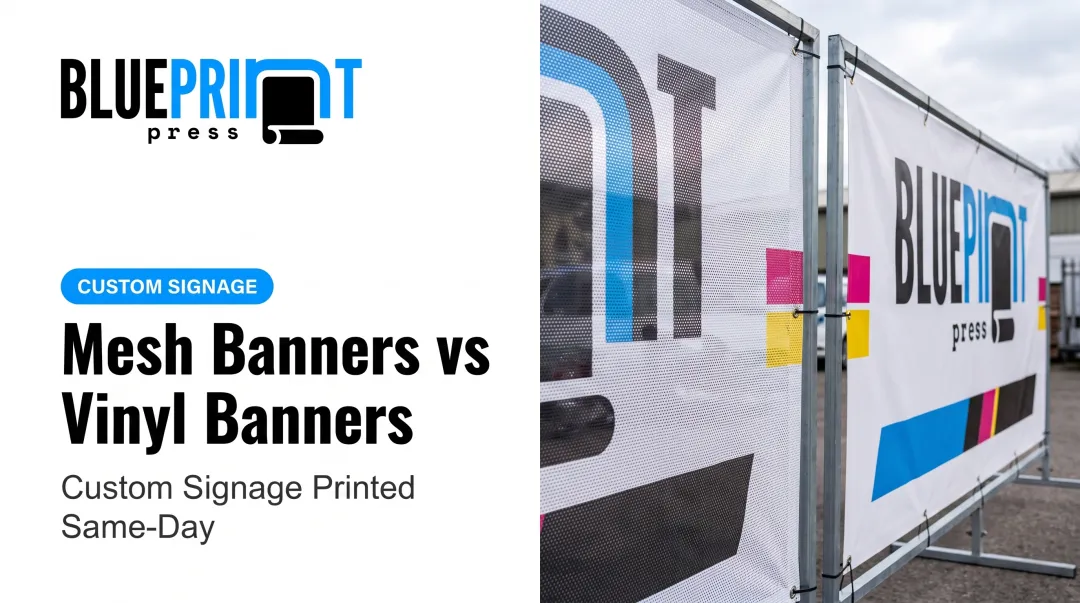
Mesh is a purpose-built alternative rather than a modified standard banner. Instead of a few concentrated cuts, mesh substrates are woven with airflow distributed across the entire surface, commonly rated around 30% porosity depending on the product. That even distribution avoids the turbulence and localized stress that concentrated slits create.
Ripstop Material
Ripstop fabric uses a reinforced crosshatch weave, with thicker yarns woven at intervals in both directions. If a small puncture or tear starts, the reinforcing grid stops it from spreading. This construction comes from parachute and sailcloth applications, where tear resistance under constant airflow stress is essential.
Heavier Block-Out Vinyl
For long-duration installations such as a full campaign season or a year-round business sign, heavier vinyl weight adds durability standard-weight material can't match, without needing any cuts at all. The extra mass resists flutter and edge fatigue that thinner stock develops in sustained wind.
Installation Techniques That Actually Reduce Load
A few hardware and setup changes matter more than any slit pattern:
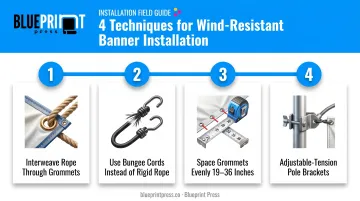
- Interweave rope through grommets rather than tying at single points, spreading tension evenly
- Use bungee cords instead of rigid rope so the banner can flex slightly under gusts instead of straining one fixed point
- Space grommets evenly (commonly every 19–36 inches) to balance the load across the entire perimeter
- Consider adjustable-tension pole brackets for pole banners; they absorb wind force at the hardware level without touching the graphic
Blueprint Press produces its wide-format vinyl and banner materials on digital equipment under union labor standards, built for durability without relying on slit patterns to manage wind exposure. Finishing needs vary by installation type (pole, fence, or street banner), so discuss grommet spacing, material weight, and mounting approach with your print provider before production starts.
Choosing Wind-Resistant Banners for Arizona's Climate
Arizona banners face a two-front problem: intense heat and UV exposure degrade standard vinyl, while monsoon season brings gusts and dust that stress every mounting point.
The monsoon threat is seasonal and severe. Arizona's monsoon runs roughly June 15 through September 30. The National Weather Service's Phoenix monsoon safety guidance notes that thunderstorm outflow gusts of 40 to 60 mph are common, sometimes with dust that cuts visibility to under a quarter mile.
Add Phoenix's average of 21 days per year at or above 110°F, and weak materials fail from heat and wind in the same season.
For banners that need to survive an entire campaign season or stay up year-round, prioritize:
- Wind slits or mesh construction to cut sail effect in monsoon gusts
- Reinforced hems to prevent fraying at the edges under repeated wind flex
- Heavy-duty grommets rated for sustained outdoor tension, not light display use
- UV-resistant inks so graphics hold up before the vinyl wears out
Blueprint Press prints vinyl and wide-format banners rated for Arizona heat, with same-day production on most orders and union pricing across the Southwest. Banners ship throughout Arizona via Employee Direct Delivery and to all 50 states and Canada—handy for nonprofits or campaigns running multi-location installs.
Frequently Asked Questions
What are wind slits on a banner?
Wind slits are half-moon cuts made into vinyl banners to let wind pass through, intended to reduce load on grommets and hardware. Testing shows the actual benefit is minimal, often 3% or less open area.
What is a wind banner?
"Wind banner" isn't one specific product. It's a general term for banners engineered to handle windy conditions, typically referring to mesh or ripstop materials rather than a standard vinyl sheet with cuts.
What is a RipStop banner?
A ripstop banner uses a reinforced crosshatch weave with stronger yarns woven at intervals. If a small tear starts, the grid pattern stops it from spreading, making it a strong choice for high-wind outdoor use.
Do wind slits actually prevent banners from tearing or blowing down?
Wind tunnel testing found slits can increase vibration and load at lower wind speeds rather than reduce it. The small amount of open area they create rarely offsets real wind pressure.
Are wind slits required by city ordinance for street-spanning banners?
Some municipalities, including San Bernardino and Napa, still legally require air relief holes or flaps on street-spanning banners. Always check local permitting rules before production.
How can I make my outdoor banner more wind-resistant without cutting slits?
Choose mesh or ripstop material, upgrade to heavier vinyl, and use proper grommet spacing with bungee cords or adjustable-tension brackets. These address wind load without altering your banner's design.