Introduction
Car wrap advertising has become one of the fastest-growing formats in out-of-home marketing. U.S. transit advertising revenue grew 9.2% year over year, outpacing most other OOH categories as brands chase mobile audiences that billboards simply can't reach (OAAA, 2026).
But pricing a car wrap isn't as simple as picking a number off a menu. Costs swing based on vehicle size, how much of the vehicle you cover, vinyl grade, and design complexity—so quotes can vary widely if you don't know what drives the price.
This guide breaks down real pricing ranges, the cost components hiding inside every quote, and how to budget smart before you commit.
Key Takeaways
- Partial wraps typically run $800–$2,500; full wraps land between $2,500–$6,000
- Premium custom wraps with specialty finishes can exceed $10,000
- Vehicle size, material grade, and design complexity drive most of the price swing
- Full coverage maximizes visibility but costs more than spot or partial wraps
- Longer-term campaigns often justify spending more on premium, weatherproof vinyl
How Much Does Car Wrap Advertising Cost? (Pricing Overview)
Most car wrap advertising projects cost between $800 and $10,000+. Your final price depends on the vehicle you're wrapping, the materials your installer uses, and the complexity of your design.
Common budgeting mistakes that inflate costs later:
- Underestimating design and labor fees baked into a "material only" quote
- Choosing a partial wrap when your visibility goals actually needed full coverage
- Forgetting to budget for eventual removal or a mid-campaign refresh
Typical Cost Range
| Wrap Type | Price Range | What's Usually Included |
|---|---|---|
| Partial Wrap | $800 – $2,500 | Doors, hood, tailgate, or rear window graphics |
| Full Wrap (Standard) | $2,500 – $6,000 | Complete exterior coverage, standard cast vinyl |
| Premium Custom Full Wrap | $6,000 – $10,000+ | Premium film, multi-color art, specialty finishes |
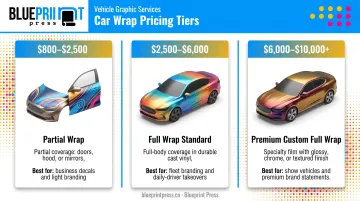
Kelley Blue Book pegs the broader full-wrap range at roughly $2,000 to $10,000-plus, with high-end custom work pushing toward the top of that band. These figures generally cover material and standard installation — they usually don't include custom design fees, paint correction, or removal down the road.
Partial Wrap
Partial wraps cover select panels instead of the entire vehicle.
- Best for: small businesses, tight budgets, or brands testing mobile advertising before committing further
- Trade-off: lower cost, but less total surface area for your message
Full Wrap (Standard)
A standard full wrap uses cast vinyl across the entire exterior with moderate design complexity.
Best for: delivery vans, single fleet vehicles, and businesses that want maximum daily visibility
Trade-off: higher upfront cost than a partial wrap, with longer install time
Premium & Custom Full Wrap
This tier uses premium cast films, multi-color illustrations, or specialty finishes like matte or chrome.
Best for: political campaigns, luxury brands, and multi-vehicle fleets that need a longer-lasting, higher-impact look
Trade-off: top-tier price; specialty finishes and complex art add production time
Key Factors That Affect the Cost of Car Wrap Advertising
Pricing comes down to five factors working together: vehicle size, wrap coverage, materials, design complexity, and labor.
Vehicle Size and Type
Bigger vehicles need more vinyl and more labor hours. Based on standard 60-inch material rolls, approximate vinyl needs are:
| Vehicle Type | Approximate Vinyl Needed |
|---|---|
| Sedan | 60–70 linear ft |
| Pickup Truck | 70–80 linear ft |
| SUV | 80–90 linear ft |
| Van | 90–100 linear ft |
Installers typically add extra material to account for seams, errors, and tricky curves, so quotes rarely reflect the bare minimum footage.
Wrap Coverage: Full vs. Partial
Full wraps maximize your advertising surface and daily impressions, but they cost considerably more than partial or spot coverage. If you want maximum brand visibility on every side of the vehicle, full coverage is usually worth the higher upfront cost.
Material and Vinyl Quality
Economy vinyl costs less upfront but fades and peels faster. Premium cast vinyl from established manufacturers costs more per square foot but holds color longer under sun and heat exposure — a real factor in Southwest climates where UV exposure is intense.
Design Complexity
- Simple logo-and-text layouts cost the least
- Multi-color or illustrated designs need specialized printing and raise the price
- Photographic wraps and tight color-matching add proofing time and push costs higher still
Installation Labor and Installer Experience
Experienced installers charge more per job. That premium buys protection against bubbling, misalignment, or peeling — problems that often cost more to fix than they would have cost to avoid.
Cost Breakdown & Smart Budgeting for Car Wrap Advertising
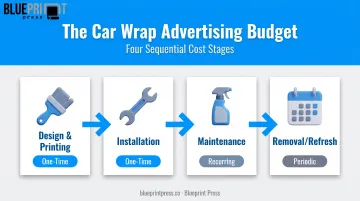
The vinyl itself is only one line item. A full car wrap advertising budget typically includes:
- Design & printing (one-time): custom graphic work and high-resolution printing shaped to your vehicle's contours
- Installation (one-time): professional labor to measure, cut, and apply the wrap cleanly
- Maintenance (recurring): wrap-safe cleaning products and hand-washing supplies to protect color and adhesion
- Removal or refresh (periodic): cost of updating branding, switching campaigns, or returning to factory paint
Budgeting tip: Request itemized quotes from a few installers before you commit, and build in vehicle downtime while the wrap is applied.
A full-service shop that handles design, printing, and production under one roof—like Blueprint Press in Phoenix—can simplify quoting and shorten turnaround. That advantage grows when you order the wrap with other campaign materials such as banners or yard signs.
Car Wrap Advertising Cost vs. Traditional Advertising (ROI Comparison)
A wrap is a one-time investment that keeps working every time the vehicle is on the road, with no recurring media buy required. 3M has pointed to fleet graphics costing as little as $0.15 per thousand impressions, a figure often cited as far below typical billboard or radio CPM.
Treat that number as a directional benchmark, not a precise current comparison. The underlying study year isn't published.
Cost behavior differs sharply from traditional channels:
- Car wrap: one upfront cost, then ongoing impressions while the vehicle is parked, idling, or in traffic
- Billboards and radio: recurring media buys that stop as soon as the budget runs out
- CPM: fleet graphics are frequently cited well below standard out-of-home and radio rates
Many businesses report faster payback than expected because that exposure does not end when a campaign flight does.
Tax treatment is a separate cost question. Don't assume automatic deductibility. The IRS makes clear that adding advertising to a vehicle doesn't convert personal or commuting use into deductible business use (IRS Publication 463). Advertising expenses have their own category on Schedule C, but how a wrap qualifies depends on your specific business situation. Talk to a tax professional before assuming a deduction.
Frequently Asked Questions
How much does it cost to wrap a car for advertising?
A full wrap typically runs $2,500–$6,000, while a partial wrap costs $800–$2,500. Vehicle size and design complexity are the biggest variables in your final quote.
Is it cheaper to paint a car or wrap it?
Basic wraps and paint jobs often cost similarly upfront. Wraps tend to be more cost-effective for multi-color designs and, unlike paint, can be removed without affecting the vehicle's original finish.
How long do car wraps last?
Most quality wraps last 3–7 years, depending on the vinyl grade, weather exposure, and how well the wrap is maintained. Horizontal surfaces like hoods and roofs wear faster than vertical panels.
Which is better: paint protection film (PPF) or a vehicle wrap?
PPF is built primarily to protect paint from chips and scratches, while wraps are built for color change and advertising. The two aren't competing options — many vehicles use both together.
How long does it take to install a car wrap?
Basic wraps take 2–3 days, while complex full wraps with custom graphics can take up to a week or more. Vehicle size and design intricacy both affect the timeline.
Can I get paid to advertise on my car?
Legitimate ad companies typically pay drivers $100–$450 per month for wrapped vehicles. The FTC has warned that offers promising several hundred dollars a week are almost always scams involving fake checks.
Conclusion
Car wrap advertising costs swing widely based on vehicle size, coverage, material grade, and design complexity — there's no universal price tag. Knowing these components upfront keeps your advertising budget on track and helps you avoid expensive surprises.
Businesses, nonprofits, and campaigns looking for fast-turnaround, union-printed car wraps at competitive Southwest pricing can turn to Blueprint Press, a full-service shop, to move from concept to a finished, road-ready wrap.