Introduction
A campaign needs 20 banners by Friday. A nonprofit has a fundraiser gala in 10 days and no signage. A restaurant wants a storefront banner that survives an entire Phoenix summer without fading.
Each of these situations lands on the same term: flex banner printing. It's one of the most requested products in the sign industry, yet few buyers know what "flex" means or how it differs from vinyl and posters.
Flex banners are PVC-based, digitally printed materials built for advertising, signage, and events. They're durable, fast to produce, and available in nearly any size. This guide breaks down what flex printing is, how it stacks up against vinyl and paper posters, and what to look for when choosing a print partner.
Key Takeaways
- PVC flex film with a scrim layer stands up to outdoor sun, wind, and rain
- Digital printing eliminates setup plates, so small and bulk orders move equally fast
- Flex material outlasts paper posters under repeated outdoor exposure
- Format choices span grommeted banners, mesh banners, backlit signs, and building wraps
- Print partner choice shapes turnaround time, color quality, and total cost
What Is Flex Banner Printing?
Flex banner (sometimes called flex board or flex sheet) refers to a flexible PVC-based material with a smooth coated surface built for large-format digital printing. "Flex" in the sign world has nothing to do with flex heat-transfer vinyl used on t-shirts and apparel. Same word, completely different product.
How the Printing Process Works
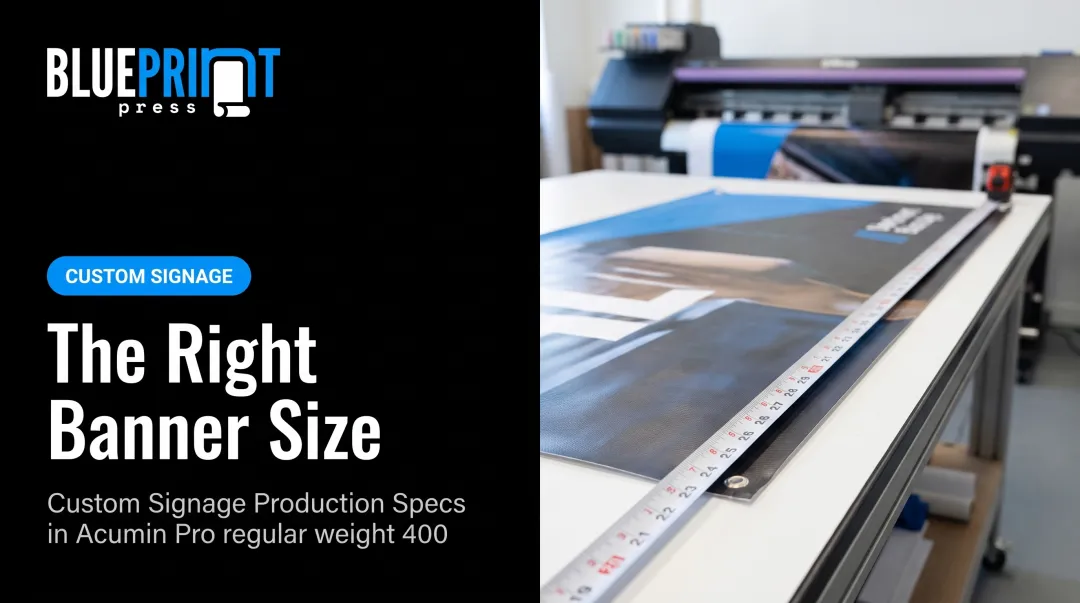
Large-format printers apply full-color graphics directly onto the PVC sheet using eco-solvent or UV-curable inks. There's no printing plate, no setup fee, and no minimum order to justify. That means a one-off banner for a Saturday event costs proportionally the same per-unit setup as a run of 50.
FESPA's ink research notes a real trade-off between the two methods: eco-solvent ink needs heat to dry and typically costs less to run, while UV-curable ink cures instantly and works across a wider range of materials, though the printers and inks themselves cost more. Neither process wins every job; the right choice depends on the material and the application.
Construction: Why Flex Banners Hold Up
Most flex banners aren't just a sheet of plastic. They're built from a woven scrim layer laminated between vinyl coatings, which is what gives the material its strength. The scrim handles tear resistance and grommet tension; the coating handles ink adhesion and color vibrancy. This layered build is why flex banners tolerate wind gusts and rough handling that would shred a paper sign.
PVC vs. PVC-Free Flex
Standard PVC flex remains the go-to for long-term outdoor use. PVC-free (sometimes labeled eco-friendly) options exist too, using alternative coatings like PET or EVA. They're lighter and better suited to short-term or indoor applications, but they generally aren't built for months of sun and rain exposure the way standard PVC is.
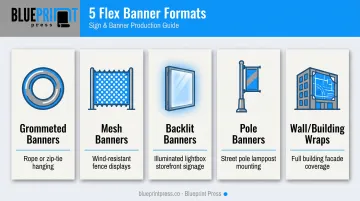
Common Flex Banner Formats
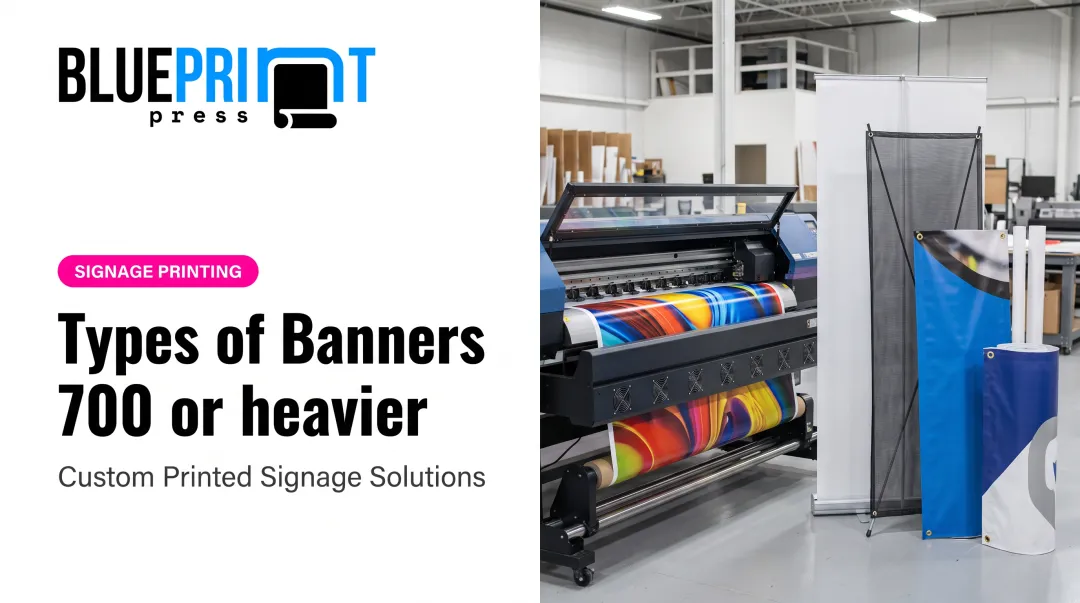
- Grommeted banners — metal eyelets for rope or zip-tie hanging
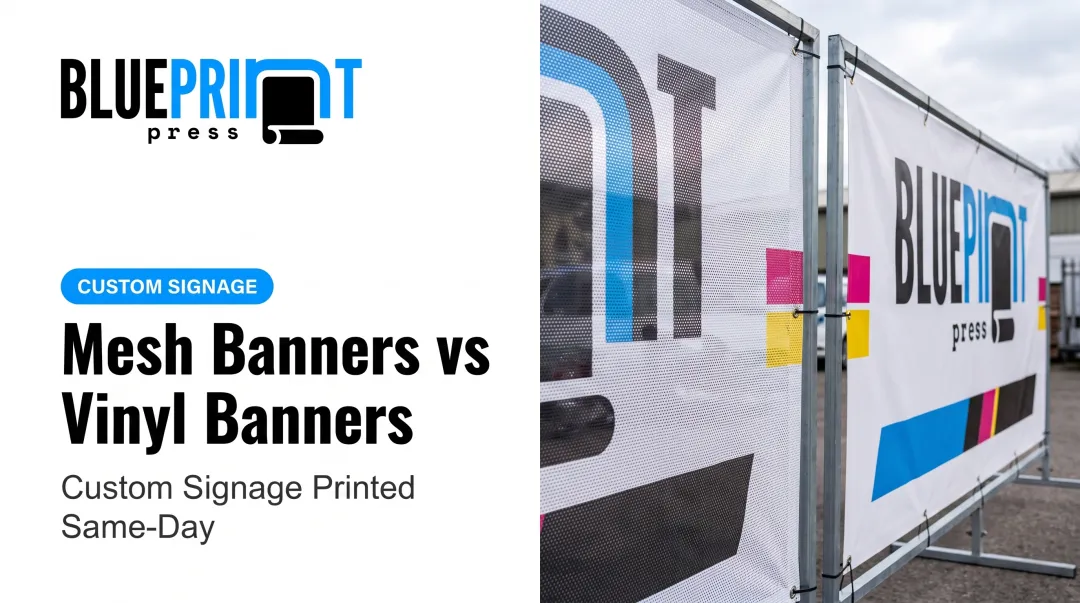
- Mesh banners — perforated material that lets wind pass through, ideal for fences and building wraps
- Backlit banners — translucent material designed for illuminated sign boxes
- Pole banners — sized and finished for street pole mounting
- Wall and building wraps — large-format coverage for facades and construction sites
Those formats keep showing up on storefronts, job sites, and campaign routes for a reason. The global large-format printer market was valued at $9.11 billion in 2023 and is projected to grow at a 5.0% annual rate through 2030, according to Grand View Research, reflecting steady commercial demand for wide-format visibility.
Flex Banner Printing vs. Vinyl and Posters
This is where most confusion happens. So let's answer it directly.
Flex banners and vinyl banners are often the exact same material. The industry uses "flex" and "vinyl banner" interchangeably for the same PVC-and-scrim construction.
Where things diverge is cut vinyl: adhesive vinyl film plotter-cut into lettering or graphics and applied to a rigid surface, like a storefront window or vehicle. That's a different product entirely from a printed banner sheet.
- Flex/vinyl banners: full sheet digitally printed, ready to hang as-is
- Cut vinyl: adhesive film cut into shapes or letters, applied to another surface
- Paper posters: printed on paper or lightweight synthetic stock for short-term indoor display
Quick Comparison
| Factor | Flex Banner | Cut Vinyl | Paper Poster |
|---|---|---|---|
| Best setting | Outdoor or indoor | Applied to signs, vehicles, windows | Indoor, short-term |
| Typical use | Storefronts, events, campaigns | Lettering, decals, vehicle graphics | Promotions, indoor displays |
| Durability | High; built for repeated exposure | High for the film itself, but limited to what it's applied to | Low; not designed for weather |
| Cost tier | Moderate, scales with size | Varies by design complexity | Lowest per unit |
When Each Material Makes Sense
- Posters: short indoor promotions, retail sales signage, one-time events
- Cut vinyl: permanent lettering on rigid signs, storefront windows, or vehicles
- Flex banners: large outdoor displays, trade shows, and campaign signage that needs to survive an entire season outside
If a banner needs to hang outside for weeks and take direct sun and wind, flex is the material built for that job. Paper simply isn't designed for it.
Key Benefits of Flex Banner Printing
Flex banner printing delivers clear advantages for outdoor campaigns, storefronts, and events:
- Weather-resistant PVC handles sun, wind, and rain across extended outdoor runs without the warping or tearing paper-based signs experience
- No plate or setup charges, so digital turnaround stays fast whether you need one banner or fifty
- Full design flexibility for high-resolution logos, photography, color gradients, and fine text at large scale
Smithers' printing industry research confirms digital processes carry lower setup costs than analog methods because there's no plate or cylinder investment before the first run. Older methods often lose detail on oversized pieces. A flex banner the size of a storefront window still prints with the same sharpness as a business card.
Best Applications and Use Cases for Flex Banners
Flex banners show up anywhere a business or organization needs a durable, attention-grabbing display:
- Outdoor advertising and storefront banners
- Trade show and exhibition backdrops
- Building and facade wraps
- Illuminated sign faces (backlit material)
- Event and stage backdrops
Political and Nonprofit Campaigns
Rally banners, campaign signage, and fundraiser backdrops all rely on flex material because campaigns can't afford signage that fades or tears halfway through election season. Fast turnaround matters just as much as durability here. A banner ordered the week before a rally needs to be ready on time, not weeks later.
Outdoor Displays in Extreme Heat
Material quality matters most for outdoor applications in punishing climates. Phoenix regularly hits normal highs of 107°F in early July, according to National Weather Service climate data. Those conditions warp, fade, or crack lesser sign materials over a single season. Reinforced PVC flex handles that kind of sustained heat exposure far better than paper-based alternatives.
Why Choose Blueprint Press for Flex Banner Printing
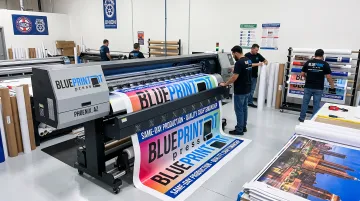
Blueprint Press is a Phoenix-based, full-service union print shop equipped with advanced digital printing equipment. That digital process produces sharper colors and cleaner edges than traditional offset printing, without the setup costs or lead times offset methods require.
What sets the shop apart on flex banner orders:
- Same-day production available on most banner orders
- Union-shop pricing that stays competitive without sacrificing quality
- One-roof convenience — add yard signs, palm cards, apparel, or direct mail to the same order
- Employee Direct Delivery across Arizona and surrounding states, putting materials directly in your team's hands
- Real-time shipment tracking for orders shipping across the Southwest or nationwide
Banner pricing runs $52 to $230 per banner, depending on size and quantity, with volume-based discounts available for larger event or campaign orders. Businesses, nonprofits, and campaigns across Arizona and beyond can get a project-specific quote, typically answered within 48 hours.
Frequently Asked Questions
What is flex in printing?
Flex refers to a flexible PVC-based material used for large-format digital printing on banners and signage. It's different from flex heat-transfer vinyl, which is used to apply designs onto apparel and fabric.
How does flex printing compare to vinyl and posters?
Flex and vinyl banners typically share the same PVC-and-scrim construction and are printed as a full sheet. Cut vinyl is adhesive film applied to another surface, while paper posters use lighter stock meant for short-term indoor use.
What's the difference between PVC flex and PVC-free flex banners?
Standard PVC flex offers superior durability for long-term outdoor display. PVC-free options are lighter and more eco-friendly, but they're better suited to short-term or indoor use.
How long do flex banners last outdoors?
Most outdoor-grade PVC flex banners last about 1–3 years, depending on UV exposure, wind, and material quality. Reinforced scrim-backed PVC outlasts unreinforced stock in the same conditions.
Can flex banners be used both indoors and outdoors?
Yes. Outdoor-grade PVC flex is built to withstand weather, while lighter flex materials work well for indoor events, trade shows, and temporary displays.
How much does flex banner printing typically cost?
Price scales mainly with size, quantity, and finishing (grommets, hems, pole pockets). Digital flex printing has no plate or setup fees, so small runs and bulk orders both stay cost-effective.