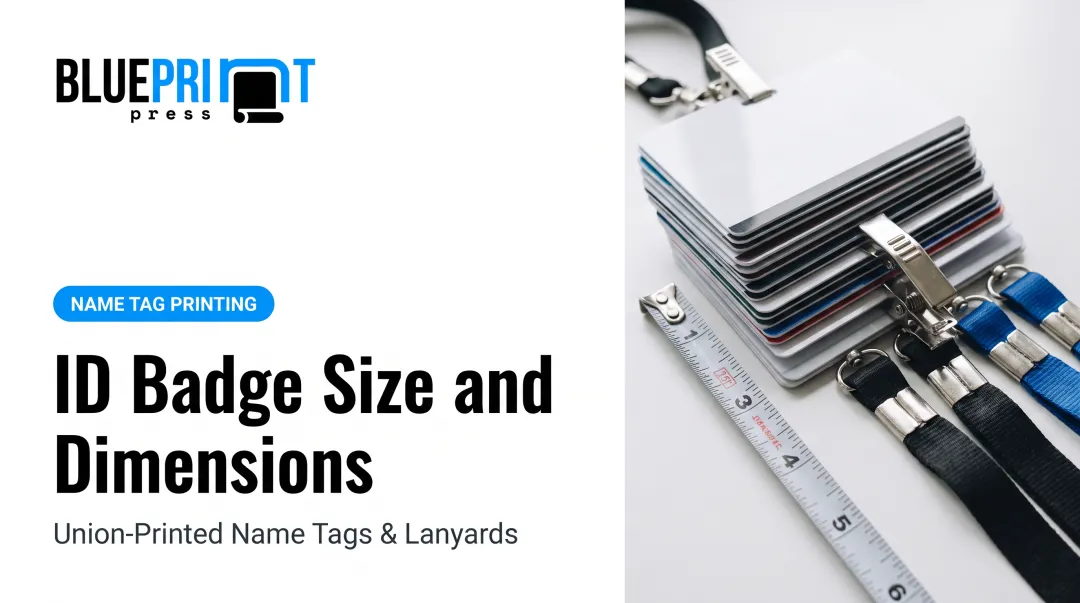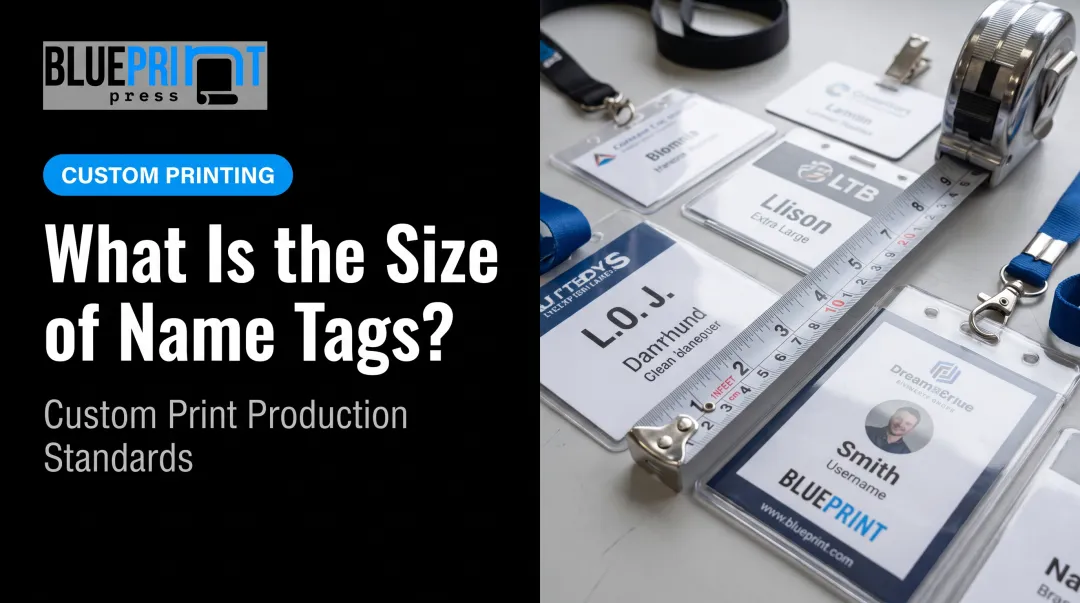
Here's the thing most organizers miss: there's no single "standard" badge size. The right dimensions depend on whether you're printing a name badge, an ID/access credential, or an exhibitor pass, and on how that badge will be worn, scanned, or displayed.
This guide breaks down real-world badge dimensions, how to match size to your event, and the print specs that keep your order from becoming a reprint.
TL;DR
- Name badges typically run 1" x 3" to 2" x 3"—1.5" x 3" is the common corporate and event size
- ID/access badges follow the CR80 standard (3.375" x 2.125"), the same size as a credit card
- Conference and trade show badges often use 3" x 4" or 4" x 6" for logos and QR codes
- Every badge file needs 300 DPI resolution and 1/8" bleed, regardless of final size
- Custom sizes work—confirm holder and lanyard fit before a full print run
What Badge Size Represents in Event Design
Badge size is simply the finished width-by-height dimension of the printed piece, not the card stock, sleeve, or lanyard it hangs from. That distinction shapes every layout and budget choice that follows.
Size acts as a hard constraint on everything else. A 1" x 3" badge physically cannot hold a name, title, department, headshot, and QR code in a legible way. A 4" x 6" badge can, but it also weighs more on a lanyard and costs more per unit.
Badge size sits between two competing priorities: practical needs (check-in speed, scanner compatibility, how fast security can verify identity) and branding goals (logo visibility, professional appearance, sponsor real estate).
What Drives Badge Size at Real Events
Design mockups rarely account for what actually happens at registration. Long lines, name lengths nobody anticipated, and lanyard weight limits all push real-world sizing decisions in directions a style guide never predicts.
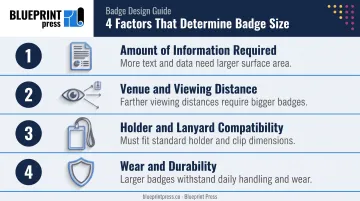
Four factors drive the size call:
- Amount of information required — Name-only badges stay small (1" x 3"). Add a title, department, credentials, or photo, and you need more surface area fast.
- Venue and viewing distance — A trade show floor demands badges readable from several feet away (2" x 3" or larger). A small office meeting doesn't.
- Holder and lanyard compatibility — Badge dimensions need to match standard holder sizes, like CR80 sleeves, or you pay extra for custom holders.
- Wear and durability — Multi-day conferences need sturdier stock and often slightly larger badges that survive repeated handling and scanning.
Skip any of these, and you'll likely be reordering badges mid-event.
Standard Badge Size Ranges and Categories
"Standard" is a loaded word here. There's no single ISO rule for name badges the way there is for credit-card-format IDs. Instead, size ranges cluster by badge type and industry use case.
Name Badge and Adhesive Badge Sizes
Corporate and event name badges generally fall into three tiers:
- 1" x 3" — Small, name-only format. Common for engraved corporate tags where the wearer's role is already understood.
- 1.5" x 3" — The most widely used size for name, title, and a small logo together.
- 2" x 3" — Larger format for name, title, department, and a bigger logo.
One-day events and open houses often use adhesive, sticker-style badges instead. These prioritize speed over detail, so attendees can grab one, write their name, and move into the room without a check-in bottleneck.
ID, Access, and Credential Badge Sizes (CR Formats)
If your badge needs to be scanned, swiped, or worn daily as an employee ID, you're working with CR formats, not name-badge sizes.
| Format | Dimensions | Best for |
|---|---|---|
| CR79 | ~3.30" x 2.05" | Adhesive overlays, proximity card inserts |
| CR80 | 3.375" x 2.125" | Employee IDs, access badges, scannable credentials (credit-card size) |
| CR100 | 2.63" x 3.88" | High-visibility exhibitor and event badges, roughly 42% larger than CR80 |
CR80 is the format most access-control systems, card printers, and off-the-shelf holders are built around. CR79 typically adheres inside a CR80 proximity card rather than standing alone.
CR100 solves a different problem: visibility from a distance at trade shows, where a credit-card-sized badge disappears against a lanyard.
Event, Conference, and Trade Show Badge Sizes
Conferences need more real estate than a corporate office badge. They carry more attendee information and more sponsor branding.
Common formats include:
- 3" x 4" — Fits name, title, company, and a QR code without crowding
- 4" x 6" — Adds room for sponsor logos, session tracks, or ribbon attachments
- 2.25" diameter circular badges — Reserved for buttons, campaign pins, or souvenir-style mementos, not primary credentials
The larger formats exist because conference badges do double duty: they're both an ID and a piece of sponsored real estate.
How to Choose the Right Badge Size for Your Event
There's no single correct badge size. There's a size that fits your specific event, and the way to find it is to work through a short set of questions rather than guessing.
Matching Size to Your Event's Purpose and Audience
Start with what the badge actually needs to communicate:
- Name only? Stay small and simple — typically around 1" x 3".
- Full credentials (title, company, department)? Move up to 1.5" x 3" or 2" x 3".
- Sponsor branding included? You're likely in 3" x 4" or larger territory.
Setting matters just as much as content. A formal corporate office favors an understated, compact badge. A trade show or political campaign event benefits from a larger, bolder format that's visible across a crowded room.
Don't overlook the material question, either. Outdoor events, campaign rallies, and multi-day festivals put badges through heat, sweat, and handling that a flimsy paper insert won't survive. Weatherproof or durable stock matters as much as the dimensions themselves.
Getting Print-Ready Specs Right
Size only matters if the print file is built correctly. Three things trip up more badge orders than anything else:
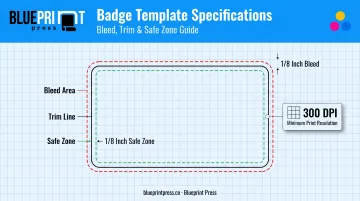
- Bleed — Extend your artwork 1/8" beyond the final badge dimension on all sides. Without it, trimming tolerances can leave an unprinted edge or clip your design.
- Safe zones — Keep text and logos at least 1/8" inside the trim line so nothing gets cut off.
- Resolution — Set artwork at 300 DPI, regardless of final badge size, for crisp, professional output.
Blueprint Press produces name tags and lanyards for events, conferences, and corporate functions, with union-printed digital production that delivers sharper color and cleaner edges than traditional offset printing.
Because badge sizing needs vary so much by event type, confirm project-specific dimensions, quantities, and turnaround with a quick quote rather than assuming a catalog size.
Risks and Common Mistakes When Sizing Badges
A few sizing mistakes show up again and again, and every one of them is avoidable with a bit of planning before the print run.
- Undersizing for the content — Cramming a title, department, and credentials onto a 1" x 3" badge forces tiny fonts that are unreadable from a few feet away.
- Assuming universal holder compatibility — Not every badge size fits standard holders and lanyard clips. Check CR80 or CR100 compatibility before ordering.
- Ignoring bleed and safe margins — Skipping this step leads to cropped logos or text after trimming, and a reprint bill nobody budgeted for.
- Using one size for every role — Staff, VIP, press, and general attendees often benefit from different badge sizes or colors, making role identification instant across a busy venue floor.
Lock in size, holder fit, and margins before the file goes to press—and you skip the reprints, unreadable type, and badges that won't clip into their holders.
Conclusion
Badge size is a functional decision shaped by how much information you need to display, how far away it needs to be read, and whether it has to fit an existing holder or lanyard.
Standard sizes work for most cases: 1.5" x 3" for name badges, CR80 for IDs and access credentials. But custom dimensions exist for events with unique requirements, whether that's a trade show needing extra sponsor space or a campaign needing a bold, distance-readable format.
Working with an experienced printer that offers fast turnaround takes the guesswork out of dimensions, materials, and print quality. You get it right on the first run, not the reprint.
Frequently Asked Questions
What is the standard size of a badge in inches?
Name badges commonly range from 1" x 3" to 2" x 3", with 1.5" x 3" being the most widely used. ID and access badges follow the CR80 standard of 3.375" x 2.125".
What size should I print something for a badge?
Set up your artwork at 300 DPI with a 1/8" bleed beyond the final badge dimensions. Keep text and logos at least 1/8" inside the trim edge so nothing critical gets cut off.
What is the most common size for a conference or event name badge?
3" x 4" is a frequent choice for conferences since it comfortably fits a name, title, company, and QR code for scanning.
Do all badge sizes fit standard lanyards and badge holders?
No. Only certain sizes, like CR80, match off-the-shelf holders and lanyard clips. Custom sizes should be checked against holder compatibility before bulk ordering.
Can I get a custom badge size for my event?
Yes. Most digital print shops can produce custom badge sizes. Confirm turnaround time and holder or lanyard fit before you place a bulk order.
What information should determine my badge size choice?
Base your size on three factors:
- How much text you need (name, title, credentials)
- How far away people will read the badge
- Whether you include a QR code or photo