Introduction
A sign that's the wrong size gets ignored, no matter how sharp the design looks. Size, not color or font, is what determines whether a driver, voter, or shopper actually reads your message in time.
That's why the sign industry leans on standard sizes for yard signs, banners, and storefront displays. These dimensions exist because they fit common frames, stakes, and printing equipment while covering most real-world visibility needs.
According to the Sign Research Foundation, viewer distance is the single most important factor in determining sign size and placement. Get the distance calculation wrong, and everything else—color, font, and layout—becomes irrelevant.
This guide breaks down standard dimensions by sign type, shows you how to calculate the right size for any viewing distance, and flags the mistakes that lead to expensive reprints.
Key Takeaways
- 18"x24" is the most common yard sign size, with 12"x18" and 24"x36" as popular alternatives
- 1 inch of letter height ≈ 10 feet of readable distance; use a stricter ratio for roadside signs
- Outdoor signs need larger dimensions and tougher materials than indoor signs
- Local ordinances and HOA rules can cap your maximum sign size, so check before ordering
- Custom sizing is available when standard dimensions don't fit your space or message
Standard Sign Sizes by Type and Use Case
Standard sizes aren't arbitrary. They emerged because printers, frame manufacturers, and stake producers converged on dimensions that balance visibility, material cost, and ease of installation. Order an 18"x24" sign today, and it'll fit stakes and sleeves made by dozens of different suppliers.
Standard Yard Sign Sizes
Five dimensions dominate the yard sign market:
- 9"x12" – Smallest common size. Best for close-range messages like party directions or graduation announcements.
- 12"x18" – Compact option for smaller yards or simple, single-line messages.
- 18"x24" – The most versatile and widely used size across real estate, political, and small business signage.
- 24"x24" – A square alternative offering similar visibility to 18"x24" with a different layout footprint.
- 24"x36" – Reserved for larger yards or situations demanding maximum visibility.
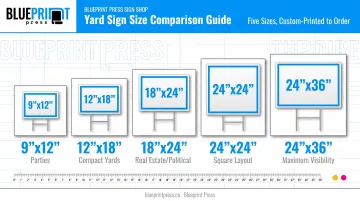
The 18"x24" format has become the industry default for a reason. It's large enough to read from the street but still easy to stake into most lawns without a second person holding it steady.
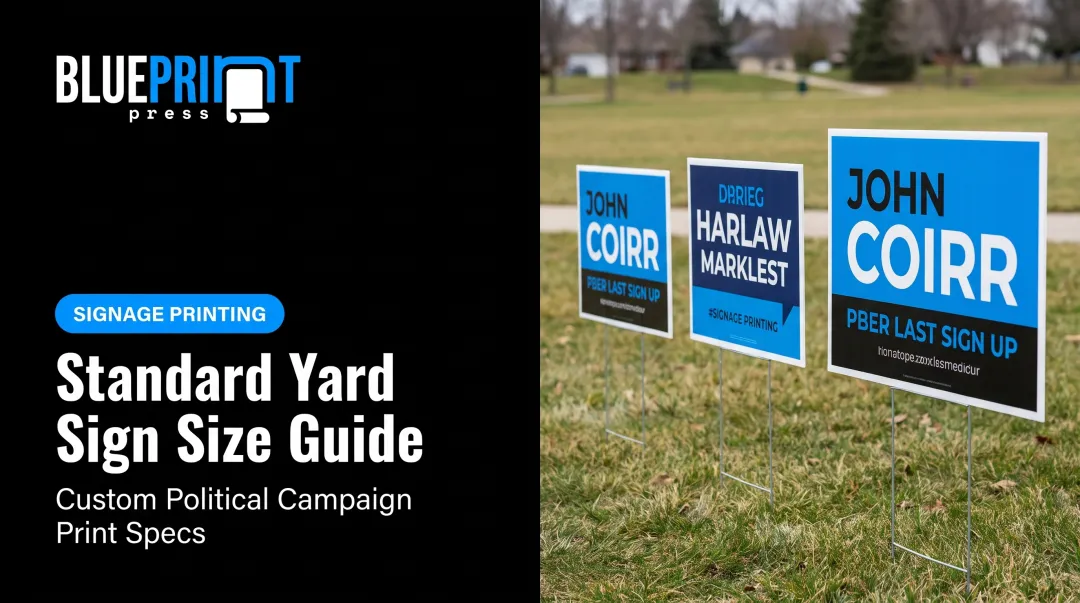
Printastic identifies 18"x24" as the standard political yard sign size and one of the most common formats for campaign use. Blueprint Press builds its political yard signs exclusively in this dimension: weatherproof 4mm coroplast with UV-resistant inks, in quantities starting at 50 from $330.
For campaigns and advocacy groups, that consistency matters. Every sign in a district looks identical and holds up through a full election cycle.
Standard Banner Sizes
Banners follow their own size conventions, largely driven by material width and mounting hardware:
- 2'x4' – Small storefront or table-top banners
- 3'x6' – Common for event entrances and sponsor displays
- 4'x8' – Standard for building facades and large promotional runs
- 5'x10' – Used for high-visibility, high-traffic placements
Material choice matters as much as size:
- Vinyl holds up best outdoors and resists rain, sun, and wind
- Mesh allows air to pass through, making it the better pick for fence lines or anywhere wind load is a concern
- Fabric generally performs best indoors, though heavier polyester fabric can survive short-term outdoor events
Standard Outdoor Business and Storefront Sign Sizes
Storefront and monument signs are the least standardized category. Common dimensions run from 24"x36" up to 36"x72", but the actual size is almost always dictated by your building's frontage and local sign code rather than a catalog preset.
Custom sizing is usually required here. Blueprint Press produces vinyl and wide-format outdoor signage built for Arizona's extreme heat, so colors stay vibrant through a full season without fading or warping—standard or custom dimensions alike.
How to Calculate the Right Sign Size for Any Distance
Forget starting with a size and working backward. The right approach starts with letter height, and letter height is a function of how far away someone needs to read your sign.
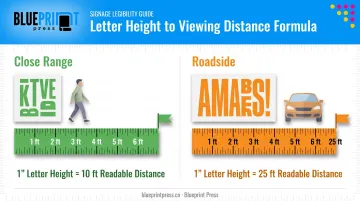
A widely used shorthand says 1 inch of letter height supports roughly 10 feet of readable distance. For casual, close-range signage, that's a reasonable starting point.
For anything viewed from a road or parking lot, use more conservative guidance. The International Sign Association recommends a minimum of 1 inch of letter height for every 25 feet of viewing distance, which produces larger, safer letters for roadside use.
Quick formula: 1" of letter height ≈ 10 ft (close range) or 25 ft (roadside).
Once you know the required letter height, build the panel around it—not the other way around.
Comparing Common Sizes: 12"x18" vs. 18"x24" vs. 9"x12"
Is 18"x24" "better" than 12"x18"? Not universally. It depends entirely on viewing distance and yard size:
| Size | Best for | Typical viewing distance |
|---|---|---|
| 9"x12" | Parties, directional signs, tight spaces | Under 15 feet |
| 12"x18" | Compact yards, simple one-line messages | 15-30 feet |
| 18"x24" | Real estate, political, general business use | 30-75 feet |
A 9"x12" sign works well for a graduation party sign on a front porch. It fails badly staked 40 feet back from a busy road. Size up when distance or message complexity increases; size down only when space or budget genuinely demands it.
Applying the Formula to Outdoor and Roadside Signage
Roadside signage adds a variable most yard signs never face: speed. A driver passing at 45 mph covers ground far faster than a pedestrian, which shrinks the window they have to notice, read, and react to your sign.
A sign meant to be read from 100 feet by a driver at highway speed needs letters well above the bare minimum—often 4 inches or taller for the primary message. Faster traffic and multi-lane roads push that number higher still.
If your sign sits along a road with a 45+ mph speed limit, don't design for casual foot traffic. Design for someone with three seconds to notice you exist.
Factors That Influence Your Ideal Sign Size
Viewing distance and traffic speed set the visibility floor. Everything else shifts your ideal size up or down from there.
Placement changes the math. A roadside sign competing with 45 mph traffic needs to be substantially larger than a residential yard sign meant for someone walking their dog past your house.
Local regulations set a hard ceiling. Before finalizing any order, especially for political and advocacy signage, check:
- City or county sign ordinances, which often cap size, height, and placement setback
- HOA covenants, which in many states can legally restrict noncommercial signs to specific square footage limits
- Right-of-way rules, which frequently prohibit signage within a set distance of the curb
Material and durability needs scale with exposure. A sign facing full sun for months needs different construction than one displayed for a weekend. Blueprint Press's weatherproof vinyl and wide-format prints are built to hold up through a full campaign season or business cycle without fading or warping in Arizona heat—so the size you choose stays readable for as long as you need it outdoors.
Common Sign Sizing Mistakes to Avoid
Three mistakes show up again and again:
- Sizing for the screen, not the street. A design that looks perfectly balanced on a laptop monitor can look tiny or cluttered once printed at full scale and viewed from 50 feet away.
- Choosing the smallest size to save money. A cheaper, undersized sign that gets ignored costs more in the end, because you'll likely reprint at the correct size anyway.
- Skipping the local regulation check. Ordering a sign that exceeds your city's or HOA's maximum size means removing or replacing it after installation, which wastes both money and time.
Each of these is avoidable with five minutes of planning before you place an order.
Conclusion
Sign size is a functional decision driven by viewing distance, how fast your audience is moving, and what local rules allow. What looks nicest on a screen rarely matches what reads well in the real world.
Standard sizes remain a reliable starting point for a reason: they're proven, cost-effective, and readily available. When your space, message, or building doesn't fit a standard mold, custom dimensions and durable, weather-resistant materials keep the sign readable and intact for the long term.
Frequently Asked Questions
What are the standard sizes for signage?
Yard signs typically run 9"x12" to 24"x36". Banners often span 2'x4' to 5'x10", and storefront signs start around 24"x36". Exact sizing depends on sign type, use case, and vendor.
Is a 12"x18" sign better than an 18"x24" sign?
It depends on placement and viewing distance. 18"x24" offers more visibility for roadside or public viewing, while 12"x18" suits compact yards or shorter distances.
How big is a 9"x12" sign?
A 9"x12" sign is one of the smallest standard yard sign sizes. It's best for close-range viewing like parties, graduations, or simple directional messages.
What is the most common yard sign size?
18"x24" is the most widely used standard yard sign size, balancing visibility with easy staking and installation.
How do I know what sign size I need for my business?
Start with the viewing-distance formula, then adjust for placement, traffic speed, and local sign regulations. Roadside signs need larger letters than pedestrian-facing signage.
Can I order a custom sign size instead of a standard one?
Yes. Custom sizes are widely available and often necessary for storefronts, unique spaces, or specific campaign needs. Request a quote to discuss dimensions outside the standard catalog.