Introduction
A badge holder that's even a few millimeters off can ruin a whole batch of IDs. Cards slip out, flip backward, or jam against the scanner right when someone needs to badge into a building.
Many HR teams, event planners, and office managers learn this the hard way—after 500 badges are already printed.
Start with standard ID card dimensions (CR80, CR79, CR100). Holder tolerances and lanyard width have to match those specs, or the fit fails.
This guide covers the size ranges that matter, how manufacturers measure holders against cards, and the bulk-order mistakes that waste a print run. You'll know what to check before you commit.
TL;DR
- CR80 (3.375" x 2.125") is the standard ID card size behind most badge holders sold today
- Holders are built slightly larger than the card itself, giving room for easy insertion and removal
- Match holder size to card dimensions, portrait or landscape orientation, and lanyard attachment style
- Mismatched holder-to-card sizing is the top reason badges fall out or flip while worn
What Badge Holder Size Represents in an ID Card System
Badge holder size isn't the card's dimensions. It's the internal pocket size, meaning the width and height of the space the card actually slides into, plus a small margin for insertion.
That margin matters. A holder needs enough room to:
- Fit the card comfortably, including any embedded chip or extra thickness
- Stay snug enough to prevent the card from sliding or rattling around inside
- Let you insert and remove the card without forcing or bending it
Holder size sits between two fixed points: the card's printed dimensions on one side, and the lanyard attachment point (clip, slot, or strap) on the other. Get either relationship wrong, and the badge either won't fit or won't hang correctly.
Why the Card Comes First
The card format drives everything downstream. Order a batch of holders before confirming your card's exact printed size, and you're gambling on a fit.
Organizations that print their own ID cards—or work with a full-service print partner—have more control here. Blueprint Press, for example, produces custom lanyards and name tags through a quote-based process, so teams lock in card size, holder, and quantities together.
When those pieces are specified up front instead of sourced separately, you catch sizing conflicts before they become a warehouse full of unusable badges.
Factors That Influence Real-World Badge Holder Sizing
On paper, a CR80 card fits a CR80 holder. In practice, several variables change whether that's actually true.
Manufacturing tolerance. Manufacturers build every holder with a small amount of wiggle room, commonly a few millimeters, so cards insert smoothly without tearing the seam. That tolerance isn't standardized industry-wide; it varies by manufacturer and SKU.
Material type. Rigid plastic holders hold their shape tightly around one specific card size. Flexible PVC pouches stretch slightly, so they handle minor size variation and sometimes multiple cards at once.
Card thickness. A standard card runs about 30 mil thick. RFID and chip-embedded cards vary more than most people expect:
- Standard access cards: roughly 30 mil nominal
- Some embedded proximity cards: up to 33 mil maximum
- Clamshell-style proximity cards: as thick as 75 mil maximum
A holder that closes fine over a 30-mil card might not close at all over a thicker clamshell card, even if the footprint matches.
Orientation. Portrait and landscape holders use the same card size but different effective openings. A card printed sideways won't sit right in a holder built for the opposite orientation.
Wear over time. Daily use, sweat, and repeated folding at the slot stretch flexible holders. A pouch that fit snugly on day one can loosen noticeably within a few months.
The Standard Range of Lanyard Badge Holder Sizes
Badge holder sizing follows the underlying card format it's built to hold, plus whatever extra room the manufacturer builds in. Three formats dominate the market.
Nominal Sizes and What They Fit
| Format | Dimensions | Typical Use |
|---|---|---|
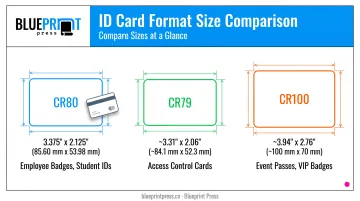
| CR80 | 3.375" x 2.125" (85.6mm x 54mm) | Employee badges, student IDs, membership cards |
| CR79 | ~3.31" x 2.06" (84.1mm x 52.4mm) | Access control cards, adhesive-back cases |
| CR100 | ~3.94" x 2.76" (100mm x 70mm) | Event passes, VIP badges, conference credentials |
CR80 matches the size of a standard credit card and, per ISO/IEC 7810, sets the ID-1 format that most access control and employee ID systems are built around. It's the size most off-the-shelf holders target by default.
CR79 runs slightly smaller, roughly 2mm shorter and 2mm narrower. According to HID's UltraCard specifications, CR79 cards are designed to be adhered inside the edge of a CR80-format card, which is why you'll see them paired with tighter access-control holders.
CR100 is the outlier: noticeably bigger, built for badges where visibility matters more than pocket-friendliness. Think conference lanyards with a company logo, attendee name, and session track printed in large type.
Allowable Tolerance Between Card and Holder
Holders aren't cut to the exact card dimension. They're built with extra room so the card slides in without catching or tearing the seam.
Rigid holders offer a tight, precise fit built for one specific card format. Flexible pouches run roomier and can sometimes accept larger cards like CR100 as well.
One CR80 pouch, for instance, lists a maximum insert of 54mm x 86mm but an outside dimension closer to 69mm x 103mm, per Specialist ID's product specifications. That gap between insert size and outside size is the buffer doing the work.
Safe Sizing Margin for Reliable Wear
Too tight, and cards crack or become hard to remove. Too loose, and they slide out or rattle around inside.
The riskiest combination pushes both variables at once: a snug CR80 holder paired with a thick, dual-chip card. That pairing might work on the first insertion and fail within weeks.
Key Properties That Define Badge Holder Performance
Size alone doesn't determine whether a holder performs well day to day. Rigidity, orientation, capacity, and attachment matter just as much.
Rigidity and Orientation
Rigid plastic holders keep a badge facing forward consistently, which helps with quick scanning and visual ID checks. Soft pouches, by contrast, can twist freely on the lanyard, flipping the badge backward at the worst moment.
Orientation compounds this:
- Vertical (portrait) holders suit single-card employee IDs with a photo and name stacked top to bottom
- Horizontal (landscape) holders work better for event badges carrying more printed text, like a name, title, and company
- Either orientation can work when the card layout is designed to match the holder you already stock
Mismatch the holder orientation to the card's print layout, and the photo or barcode ends up sideways when worn.
Capacity and Attachment
Some holders carry just one card. Others hold two, back to back, which changes the required internal depth, not just the width and height.
That capacity decision comes with a trade-off. Multi-card holders give more room for information, but they're bulkier and more likely to catch on equipment in warehouses, hospitals, and other high-movement settings.
The attachment point matters too. A badge holder without a properly matched clip or slot width can twist or detach mid-shift, especially in jobs involving a lot of physical movement.
Measuring, Specifying, and Avoiding Common Sizing Mistakes
Before ordering hundreds of holders, a few checks catch most sizing problems before they become expensive.
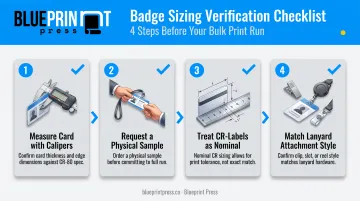
- Measure the actual card with calipers, including any embedded chip thickness. Don't rely on the CR-format name alone; printers can produce cards at slightly different tolerances than the nominal spec suggests.
- Request a physical sample of the holder-and-card combination before a full print run, particularly when pairing custom-sized ID cards with standard off-the-shelf holders.
- Treat CR-size labels as nominal, not exact. IDenticard and HID round CR79 dimensions slightly differently, so a labeled "CR80" isn't one universal measurement across every vendor.
- Match the lanyard to the holder's attachment style. A holder without a properly paired clip or slot width can twist, flip backward, or detach during daily wear.
Working with a single print partner for the card, holder, and lanyard reduces how many separate tolerances you're stacking. Sizing decisions stay centralized instead of split across three vendors.
Blueprint Press handles custom lanyards and name tags for organizations through its quote process. Teams submit quantity, budget range, and project details and typically hear back within 48 hours.
Conclusion
Badge holder size controls fit. It depends on the ID card format you use—CR80, CR79, or CR100—and on how that card's tolerance, thickness, and orientation work with the holder.
Match those factors, and account for how the lanyard attaches, and you avoid the two most common failures: cards falling out and badges flipping backward mid-shift.
Don't rely on a spec sheet alone. Request a physical sample of the card-and-holder combination before you place a bulk order so the fit is right the first time.
Frequently Asked Questions
What is the standard size of a lanyard badge?
Most lanyard badge holders are built to fit the CR80 card format, 3.375" x 2.125", the same size as a standard credit card. CR79 and CR100 holders are also common, for access control and event badges respectively.
What is the difference between CR80, CR79, and CR100 card sizes?
CR80 (3.375" x 2.125") is the everyday ID standard. CR79 is about 2 mm smaller per side for tighter access-control cases. CR100 (about 3.94" x 2.76") is larger for event and VIP badges.
How much bigger should a badge holder be than the ID card?
Holders typically allow a few millimeters of clearance on each side for easy insertion. Rigid holders keep tolerances tight and precise, while flexible pouches allow more room and can sometimes fit slightly larger cards.
Can I put a CR80 card in a CR100 holder?
Technically yes, but it's a poor fit. A CR100 holder is noticeably larger than a CR80 card, so the card shifts around inside and looks unprofessional when worn.
What lanyard width works best with which badge holder size?
Narrower lanyards pair comfortably with smaller CR80 or CR79 holders for everyday wear. Wider lanyards suit larger CR100 or event holders, where visibility and a more substantial feel matter more.
Do badge holders come in vertical and horizontal orientations?
Yes. Orientation should match how the ID card is printed, so the photo, barcode, and text all display correctly and right-side up when the badge is worn on a lanyard.